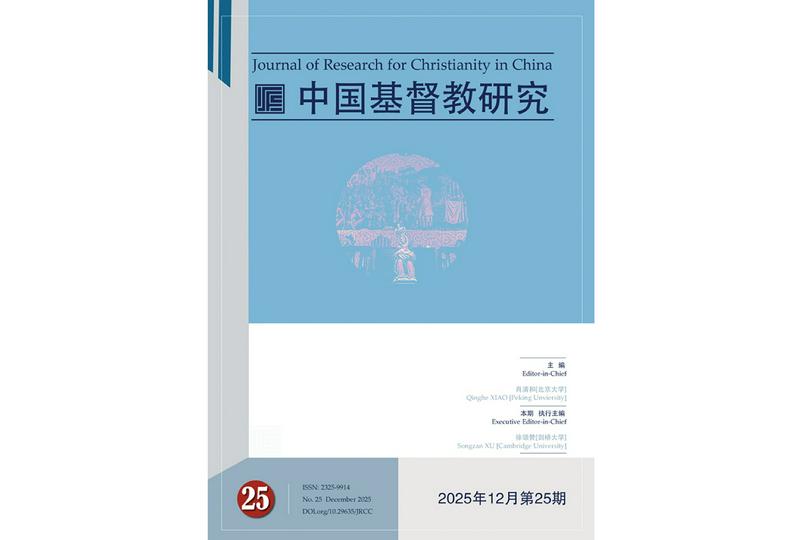
Journal for Research of Christianity in China (JRCC) has published its latest issue, presenting new research on Chinese church history, theology, and the interaction between Christianity and Chinese society.
According to the Chinese Christian Studies, the issue covers a paper that discusses the conception of an ideal world present in T.C. Chao's (Tsu Chen Chao) (1888-1979) early theological works. Scholar Buxiao Ni documents the Christian and Missionary Alliance's work in Guangxi through life histories of converts from multiethnic communities, while Sian-Chin Iap offers a new interpretation of Paul Wei's role in China's early independent church movements. Studies by Ximing Xue, Siqi Wang, and Shoukang Tang explore how churches in Guangdong, rural Shandong, and late Qing Fujian responded to shifting social conditions, indigenization needs, and new evangelistic models. Lingyun Wu reevaluates Chiang Kai-shek's Christian faith in 1949 through sources from Ningbo, and Haoyi Zhang, with Yongchao Zhang, investigates how Thomas Aquinas' thought shaped Catholic theology and philosophy in Ming and Qing China.
The issue also includes research on identity formation in the Book of Ruth, the interpretation of the woman in Revelation 12, implicit Mariology in Paul's epistles, East Syriac Eucharistic tradition, and Trinitarian theology in interreligious dialogue. Review essays examine the integration of Laozi and Christian thought, Christianity's contribution to human civilization, and recent publications from the Institute of Macao Studies.
The Journal of Research for Christianity in China, a semiannual publication, is published in June and December every year. While the journal primarily focuses on the study of Christianity in China, it also welcomes scholarly articles addressing Chinese philosophy, thought, culture, and religion.