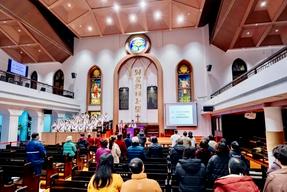
Two decades ago, China’s urban churches embraced ambitious visions for the future. Today, a scholar reflects on those hopes, their legacy, and the realities that followed.
China’s Christian landscape, the state-approved Three-Self churches, and the house churches have been a topic of discussion that has attracted global attention. Nigerian Christians who are under intense persecution sometimes view the Chinese church through simplified narratives. But some erroneous impressions must be corrected.
A church library’s function goes far beyond simple reading. It is another field for nurturing believers and pastors, and it forms a Christian knowledge service system.
Recently, 200 Ukrainian evangelicals travelled to Washington, D.C. in order to participate in a government-sponsored “Ukrainian Week” from 3 to 8 February. More than a few of them were then present at the annual National Prayer Breakfast in that city on 6 February. Roughly 15 pastors arrived from Russia to attend the Breakfast.
Nezha is a significant figure in ancient Chinese mythology and religious traditions, appearing in popular TV series such as Journey to the West and Investiture of the Gods. In real life, Nezha is also revered as a protective deity, enshrined not only in temples and Taoist shrines but even in dedicated Nezha temples in some regions.
A Christian who has stayed in a city for the first time during the Chinese New Year noticed that the number of people attending the urban churches during the festival is small, with some churches having only a quarter of their original number, and midweek fellowships also being suspended.
The true meaning of going home for the Spring Festival is not to show off superficial appearances, nor to satisfy the gossip and chatters of the village. It is about family reunions and seeing the loved ones we have been apart from for a whole year.
Religious discrimination hinders the spread of the gospel, obstructs the development of the localization of Christianity in China, and impedes friendly relations and exchanges between Christianity and other patriotic religions. Discarding prejudice will broaden our horizons and enable the widespread dissemination of the gospel.
During my past two-year psychological counseling work, I can clearly feel that more and more exceptional teenagers come to consult me, but they receive much less help than they should.