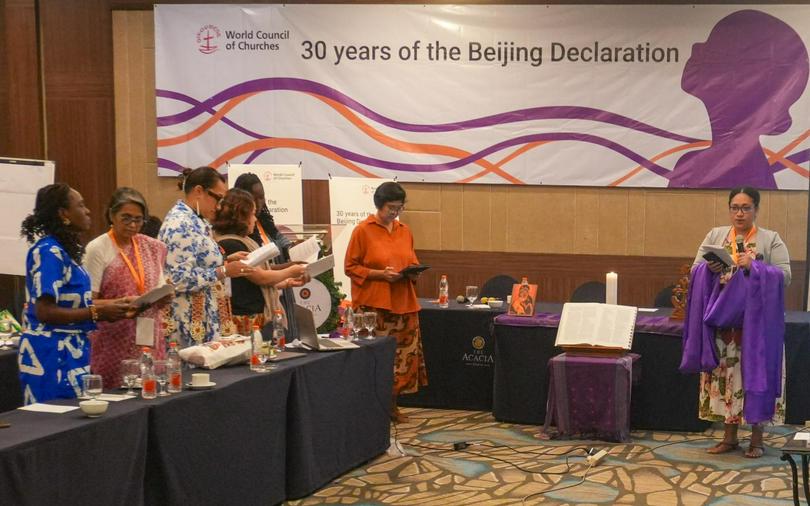
Marking 30 years since the adoption of the 1995 Beijing Declaration and Platform for Action, participants from the Asia Pacific member churches and partners of the World Council of Churches (WCC) met in Jakarta, Indonesia, to reflect theologically, contextually, and practically on the commitments of the Beijing Declaration and Platform for Action in the current global context.
The Beijing Platform for Action is a global agenda for gender equality and women's empowerment, adopted in 1995 at the Fourth World Conference on Women in Beijing.
The consultation has issued the "Jakarta Declaration 2025: Witnessing and Anticipating Gender Justice in Unity and Diversity," which focuses on the past, present, and future of the WCC's commitment to gender justice.
"We recognize that gender justice cannot exist without the transformation of power," reads the declaration. "We further acknowledge that women and girls with disabilities face disproportionate barriers to participation, safety, education, leadership, and economic opportunity, and commit to ensuring accessibility, inclusion, and the dismantling of ableist structures within our churches."
The declaration sets the goal of achieving equal representation of women in all WCC delegations and leadership bodies by 2030. "Like the women who stayed with Jesus at the cross and were first witnesses of his resurrection, throughout history women have been prophets, proclaimers of God's will, and participants in the eschatological renewal of the world," reads the declaration. "We additionally commit to ensuring that worship spaces, liturgical resources, and theological materials reflect the diversity of women's experiences across ability, age, ethnicity, and culture."
The declaration further commits to ecumenical diakonia, recognising that the feminization of poverty and the vulnerability of women and girls to environmental degradation, caste-based discrimination and violence, displacement, and conflict are transversal realities faced across all faith traditions, demanding contextual solidarity.
"We affirm the voices and leadership of Indigenous, grassroots, and Pacific women who bear the gendered impacts of climate change," reads the declaration. "We honour the testimony from the Marshall Islands, where rising seas and the enduring trauma of nuclear testing threaten life, land, and future generations; and we acknowledge the prophetic courage of West Papuan women who confront militarisation, sexual and gender-based violence, and the erosion of cultural and spiritual identity."
Echoing the Pacific Conference of Churches, the declaration affirms that gender justice in the Pacific is inseparable from ecological justice, nuclear justice, decolonisation, and the struggle for sovereignty and survival.
"We affirm that the spiritual and cultural wisdom of Pacific and Indigenous women—rooted in land, ocean, genealogy, identity, and community—must shape our theological reflection, peacemaking, and pursuit of justice across the region," reads the text. "Affirming the shared ethical teachings present across our religious traditions, teachings that uphold the dignity, protection, and flourishing of women, girls, people with disabilities, and all children, we pledge to deepen interfaith cooperation for the common good."
The declaration pledges to forge strong alliances between communities of faith and global movements for justice.
"Churches must be proactive agents of healing and truth-telling, not silent in the face of injustice," reads the declaration. "On our pilgrimage to gender justice, we recognize that the Holy Spirit works through the diverse contexts and temporal rhythms of our churches."
This pilgrimage must be guided by mutual respect within the fellowship of churches, notes the declaration. "We call upon all member churches to implement these commitments through concrete local actions, to resource gender justice ministries, and to integrate these principles into governance, formation, pastoral care, and public witness," the message reads. "We pledge to walk together in courage and solidarity, reclaiming the future God intends – a future where justice is lived, healing is embodied, and all creation flourishes."
Originally from the World Council of Churches
CCD reprinted with permission