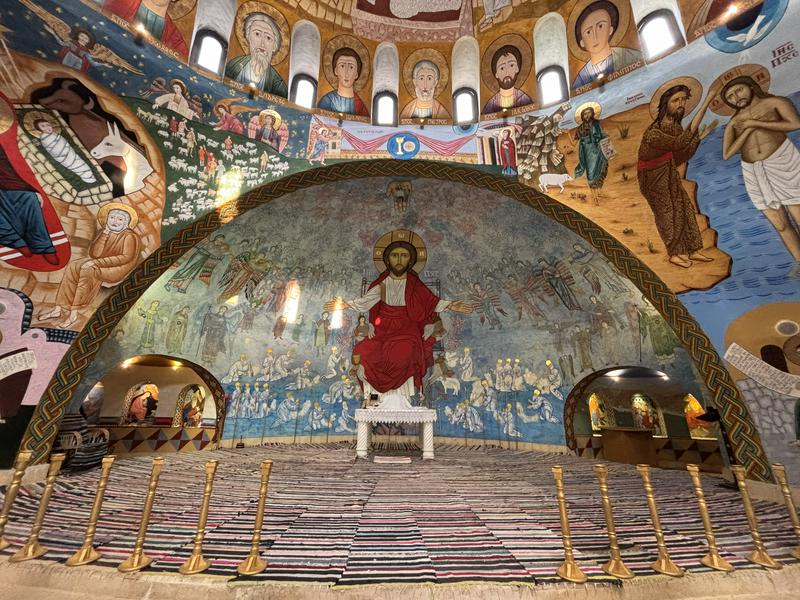
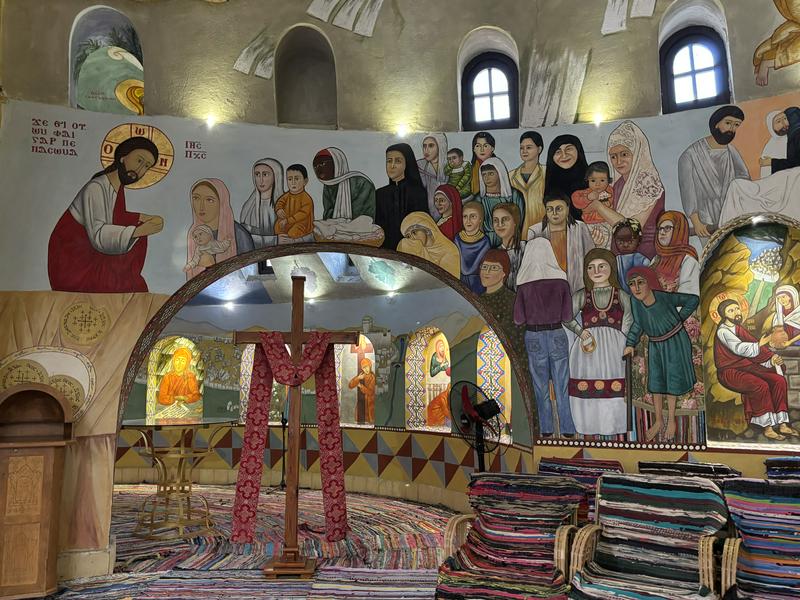

Nestled within the Anaphora Retreat Center, the Church of the Resurrection stands as a masterpiece of contemporary sacred art with ancient Coptic tradition. This sanctuary, with all its walls adorned with iconography, is the result of over a decade of dedicated labor by Helena Nikkanen, a renowned Finnish artist and art conservator, who worked alongside her Coptic sisters.
Anaphora, a name meaning "to lift up," is a non-profit retreat center and farm located in Wadi El Natrun, approximately 75 km north of Cairo, Egypt, according to its official website. Founded in late 1998 by His Grace Bishop Thomas, Bishop of El-Quossia (Upper Egypt), the center spans 120 acres and has become a spiritual hub.
The architecture of the church itself serves as a physical passage through the history of salvation. Under the vision of Metropolitan Thomas, the team designed the exterior walls to depict the foundations of the Old Testament. As visitors cross the threshold into the sanctuary, they "enter" the grace of the New Testament, where the walls bring the Gospel to life.
Nikkanen, a recipient of the Finnish Cultural Fund's Award and a founding member of the Finnish Egyptological Society, began this monumental task following her retirement. At age 77, she proves that the call to serve knows no age. Traditional icons of the Ascension or the Transfiguration—characteristic of the Coptic Church and distinct from those of other Orthodox churches—are "the subject of the altar," Nikkanen told China Christian Daily.
Christ sits on the throne, while there are four creatures around him. "If you look at the red garment of Christ, each of them has six wings and thousands of eyes, as it says in the Revelation of John," she said. Twenty-four elders in white clothes with incense bowls kneel down, while seven angels blow the trumpet. There are symbols of "seven" horns, eyes, seals, and torches. There is also an old iconography where Christ gives his body as bread and wine to the apostles.
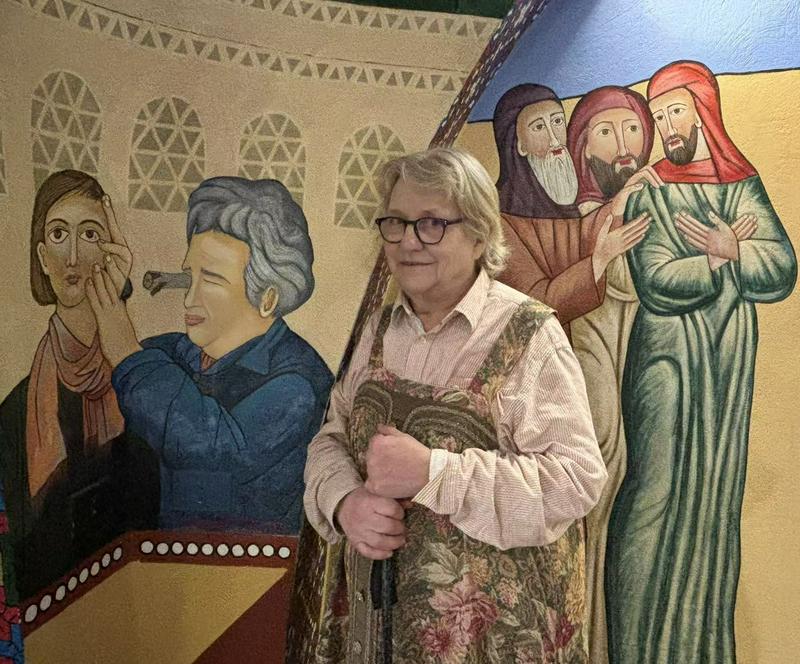
While she adhered to traditional iconography, Metropolitan Thomas encouraged her to create original works that avoid rigid imitation, resulting in a "living" style that breathes with a contemporary spirit. There are two scenes representing modern people: one shows Jesus reaching out to children and women of different ethnicities and religions, inspired by Matthew 25:40; the other depicts a woman examining the speck of sawdust in her younger sister's eye while a plank remains in her own. Nikkanen revealed that she was the prototype of the woman.
In Coptic tradition, iconography is called "visual theology," which serves as a liturgical function as an integral part of the Coptic worship, Ilaria Ramzy from New Orleans' St. Mark Church wrote in his article titled "The Art of Iconography." Believers can achieve a prayerful mindset to use icons as "windows into the spiritual world."
As the largest Christian community in the Middle East, the Coptic Orthodox Church has an estimated membership of 11 million in Egypt and one million abroad, according to the World Council of Churches. Traditionally founded by Saint Mark, the church endured significant persecution in the early centuries, a period that fostered the birth of Christian monasticism. Today, twenty monasteries and seven convents remain as active spiritual centers—the remnants of the hundreds that once flourished across the Egyptian deserts. The Coptic language is largely used in the church, along with the Arabic text in parallel.