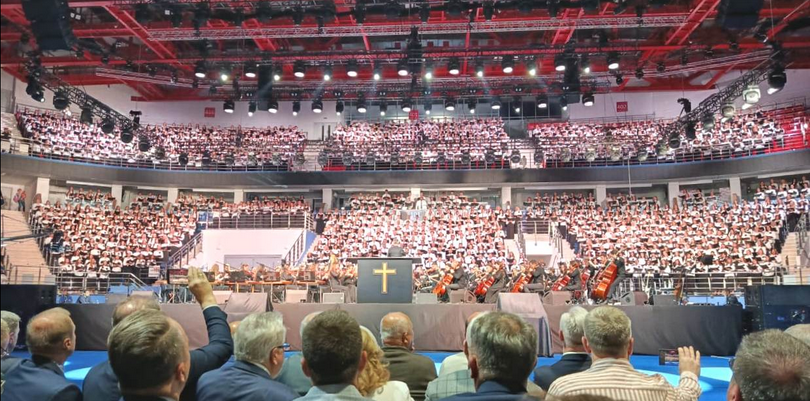
L a d u s h k i n / R u s s i a -- Ignoring the U.S.-State Department's level 4 warning to avoid all travel to Belarus, the evangelist Franklin Graham preached to overflow crowds in Minsk's Chizhovka Arena on May 16 and 17. Franklin, the son of Billy, even brought along a message from Donald Trump. Hundreds needed to be turned away after the arena's 11,000 seats were filled. In fact, local Protestant churches had admonished their flocks to remain at home in order to open up seating for seekers. Yet as many as 15,000 may have attended the closing service. In Belarus, a live stream of the event was available.
In his meeting with Graham on May 15, Belarusian president Alexander Lukashenko indirectly attacked the traditional Orthodox belief that Protestants are sectarian. He labelled evangelical believers the "very best" of all citizens, citing an unnamed Baptist farmer who toiled under his leadership in Mogilev region during the 1970s. That now-elderly farmer is Vladimir Malinovsky. The Belarusian president mentioned as an aside that the farmer has a son residing in the USA. An official government press release quoted Lukashenko in its title: "The Interconfessional World is a Belarusian Trademark". Lukashenko added: "We are proud of the interfaith peace that exists in Belarus", noting that his country is home to 850 Protestant congregations, 20 mission societies and five institutions of learning.
In this instance, Franklin Graham adhered closely to the loyalty demanded by Romans 13. During the opening service, he left several minutes for attendees to pray out loud for both Lukashenko and Russian president Vladimir Putin. In his sermon that evening, Graham strongly lauded Belarusian society, citing its cleanliness and order.
Due in part to their historical aversion to relations with the state, local Protestants are squeamish regarding this close cooperation between Franklin's "Billy Graham Evangelistic Association" (BGEA) and the Belarusian government. Yet they were elated by the cross-denominational cooperation achieved during preparations for the event. The mass choir of 1,300 voices covered the gamut of Belarusian Protestantism. But Orthodox and Roman Catholic clergy were made conspicuous by their absence. Original efforts in 2018 to hold a Festival of Hope had floundered due in part to internal Protestant tensions.
Protestants were grateful that their Western friends have not forgotten them. During their Sunday church service, a pastor at the Baptist "Light of Truth" congregation in Minsk expressed gratitude to North America's Protestants. They had cared enough about their Belarusian compatriots to fund the current event.
During the meeting with Graham on the 15th, Lukashenko had noted that two-thirds of the humanitarian aid Belarus received during 2025 came from the United States. Much of that was apparently from the BGEA's "Samaritan's Purse". Despite the Western hue and cry for sanctions, the Belarusian president assured that "Americans are doing a great job".
Though several Russian leaders such as the Baptist Union's Peter Mitskevich and the Norwegian Pentecostal Matts-Ola Ishoel, the head of Moscow's largest Protestant congregation, were present, no delegations from Ukraine or the West appeared. Western journalistic presence was limited to yours truly, though I only qualify as half-Western due to my Russian passport and residency. I assume it was mostly deference to evangelical sensitivities in Kiev that kept West European reporters away from this significant church happening.
One Western mission other than the BGEA did attend: The Cumming/Georgia-based "Byelorussian Mission" brought a delegation of five. Its head, the Belarusian-American Andrew Ryzhkov, exclaimed in a private conversation that Belarus could become a springboard for mission throughout the ex-Soviet Union. He noted with deep appreciation that Belarus' highest-level diplomat in the USA, the Washington-based chargé d'affaires Pavel Shidlovsky, had visited Cumming's "Calvary Russian Baptist Church" several weeks hence. Ryzhkov praised the cordiality of Belarusian authorities, even those at the border.
Commentary
Security levels were extremely high at the Festival. After spending a few minutes near the stage before the opening evening, a representative of the BGEA saw to it that state security frisked me thoroughly for a second time. I even needed to promise the representative that I would not be storming the stage. Due to my advanced age, I was able to both make and keep that promise. Though not requested, I was assured I would receive no access to Rev. Graham.
Things had been much more relaxed in the old German Democratic Republic. When Billy Graham (1918-2018) preached there in October 1982, we journalists were given reasonable access and allowed to ask the evangelist questions at press conferences. This event, in contrast, was not designed to welcome the media. But there is now war next door to Belarus and we have a great cloud of West European politicians proclaiming that nuclear-armed Russia dare not be allowed to win. The BGEA was understandably nervous.
This Festival was more concert than sermon: Only after 80 minutes of music did Franklin Graham make a relatively brief appearance at the final service. The actual content of BGEA events is rarely newsworthy. Very significant though, is the fact that this event took place at all.
I personally am no fan of flashy and expensive church gatherings. Yet Belarusian believers were thrilled for being remembered at a time of war and adversity. I am therefore in no position to criticise that sentiment. The majority of Western evangelicals may be critical of the Belarusian government, but there is peace in this country. That situation is far better than the current agony of Ukraine.
Alexander Lukashenko has a history of negotiating between the fronts, making advances to both East and West. The BGEA has practiced a similar policy of mixed signals, of playing tennis in both courts. In his initially-secret memo to President Richard Nixon on 15 April 1969, Billy Graham had recommended that the US bomb the dikes of North Vietnam. That would have endangered the lives of millions. Twenty-three years later, in April 1992, he was photographed in Pyongyang doing a half embrace with North Korea's Kim Il Sung.
Franklin Graham has exhibited great courage by coming to the non-NATO world at a time of major war hysteria. Yet on April 2, in a prayer spoken in the presence of Donald Trump, he had supported the attack on Iran. Graham had claimed thereby that Persians retained an ancient hatred for Jews, citing the Amalekite Haman in the book of Esther. Yet Cyrus the Great, also called Cyrus the Persian, was a true friend of the Jewish nation and definitely a Persian - which Haman was not. Perhaps Franklin Graham is a spokesman for both peace and war.
Whether the current Belarusian charm offensive is a cause for hope or suspicion depends largely upon the ideological house in which one resides. The adherents of traditional family values are usually more supportive of a quick peace treaty under the current circumstances than the West's liberal and "globalist" majority. But there are also more than a few conservative opponents of reconciliation with the East. Andreas Patz, a Russian-German publicist and pastor living near Saarbrücken, reported in May 2025 that he would reckon with arrest if he appeared at a Belarusian border crossing.
On May 12 and 13, the Council of the "Russian Union of Evangelical Christians-Baptists" (RUECB) convened in Moscow, re-electing Peter Mitskevich for a third four-year term. Global Baptists had not forgotten the sessions, sending the presidents of both the "Baptist World Alliance" and the "European Baptist Federation" to Moscow. But the former is the Jamaican Karl Johnson and the latter is the Lebanese Charles Costa. A third official Baptist visitor was from the Central African Republic. A Russian-German from Germany also came, but other representatives from the political West were nowhere to be seen.
Is the delegation composition in Moscow a harbinger of things to come, or are the Minsk festivities also a possible, long-term option? Was Minsk a curtain call, the final gasp, or rather a restart/reboot of the golden quarter century of East-West church relations that had begun in 1990?
Georgia's Andrew Ryzhkov reckons with a resumption of the old. But if YouTube sages such as John Mersheimer, Alexander Mercouris, Jeffrey Sachs and the Norwegian Glenn Diesen are to be believed, then the globe is standing on the brink of a new world order. If a world war can be avoided, then the best one can hope for is that Russia and its allies simply pivot from an East-West to a North-South orientation as symbolised by BRICS.
Do the evangelicals of non-NATO Europe have the strength and imagination to realign themselves into a North-South configuration, replacing their Western contacts with Chinese, Indian, South African and Brazilian ones? Since Russian and Belarusian evangelicals now have half of their co-believers and relatives in the West, such an adjustment would be very painful. (The numbers look more grave in Ukraine.) The mood in Moscow last week was less than optimistic. Brains are still draining westward; one observer noted that RUECB-membership has dropped from 80,000 to 65,000 in the course of the last decade. With numbers like that, the Russian-speaking evangelical world has become a kind of divided Germany.
Adjusting to a totally new state of affairs will demand a major amount of thought and debate among those who have remained at home. This assumes that the "golden age" is gone, at least for the coming decades.
Originally from the Faith in Eurasia
CCD edited and reprinted with permission