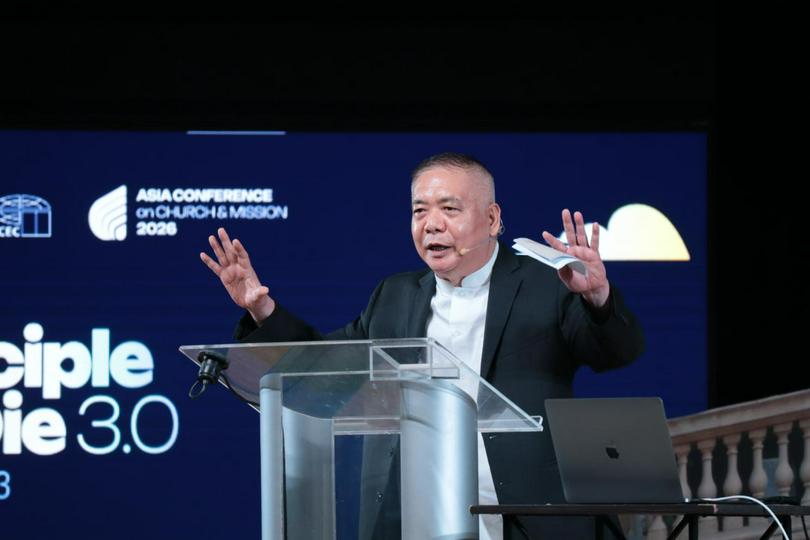
At ACCM 2026, 'Disciple or Die' Challenges Churches to Move From Growth to Formation
The Asia Conference on Church and Mission (ACCM) 2026 was held from June 9 to 11 in Metro Manila, the Philippines, gathering more than 200 pastors and church leaders from 25 countries. Hosted by the Asia Evangelical Alliance, this year's conference carried the theme "Disciple or Die 3.0," calling Asian churches to recover intentional disciple-making as a central task of Christian mission.
One theme that continued to stay with me throughout the conference was the very phrase itself: "Disciple or Die."
Taken literally, the phrase sounds stark, even unsettling. It means that if the church does not make disciples, it will die. At first hearing, it can sound like a slogan designed to create urgency. But after several days of sessions, conversations, and interviews, I began to understand that it was not merely rhetorical. It reflected a conviction that the Asia Evangelical Alliance has been developing over nearly a decade: the real crisis of the church may not be declining attendance, limited resources, or external pressure, but the possibility that churches can still have services, programs, events, and institutional activity while failing to form followers of Christ who can also help others follow Him.
One of the key figures behind this emphasis is Dr. Bambang Budijanto, general secretary of the Asia Evangelical Alliance. In the interview with China Christian Daily, he traced his concern for disciple-making back to a research report that deeply disturbed him.
In 2015, Barna Group and The Navigators released The State of Discipleship, a study that explored how American Christians understood and participated in discipleship. According to Budijanto, the finding that struck him was that only about 20 percent of Christians surveyed reported being involved in some form of discipleship activity. Even that figure, he emphasized, did not necessarily mean they were actively discipling others. It could simply refer to attending Sunday school, a Bible study, a small group, or a similar church activity.
The result grieved him.
"We say we love Him, we say we honor Him, but only 20 percent," he said. "Eighty percent disobey Jesus' command."
What saddened him even more, he added, was that many church leaders knew this reality but continued to carry on with church anniversaries, programs, camps, and conferences as though everything were fine. He used the analogy of a human body: if 80 percent of the body's functions stop working, that body is dying. It cannot continue to operate as usual. The same, he said, is true of the church.
For Budijanto, Jesus' final command before His ascension was to "Go make disciples." In Asian cultures, he noted, final words are often regarded as especially important because they summarize what a person most wants to leave behind. Jesus' final commission was not merely to bring people into religious gatherings, nor simply to get people to attend church activities. It was to make disciples.
***
This sense of alarm first entered AEA discussions at its 2016 gathering in Bandung, Indonesia. At that time, not everyone was immediately interested in the topic. Some wondered why such a simple theme should be discussed at a major assembly. It did not sound theologically complex or sophisticated.
In 2019, the World Evangelical Alliance held its General Assembly in Indonesia, its first such gathering since the 2008 assembly in Pattaya, Thailand. Budijanto served as chair of the program team. Before beginning the formal work of designing the program, he recalled, the team spent three days in prayer, seeking God's direction for the gathering.
"Very clearly, God spoke about discipleship," he recalled.
At the conclusion of the 2019 assembly, WEA launched the "Decade of Disciple Making" for 2020 to 2030, calling the global evangelical family to refocus on disciple-making.
The following year, as the COVID-19 pandemic reshaped the world, AEA held its General Assembly online for the first time under the theme "Asian Church in the New Landscape." Budijanto said that, in that moment, they realized how much had changed: the world had changed, the shape of mission had changed, and the situation of the church had changed. Yet several things had not changed: Jesus Christ, the church as the bride of Christ, and the Great Commission. The more the world changed, the more the church needed to strengthen what remained unchanged.
After several years of observation, research, and prayer during and after the pandemic, AEA formally introduced the theme "Disciple or Die" at its 11th General Assembly in Ulaanbaatar, Mongolia, in 2024. If the Mongolia gathering was a wake-up call that placed the discipleship crisis before Asian evangelical leaders, then "Disciple or Die 2.0," held in South Korea in 2025, turned that wake-up call into strategic mobilization, focusing on children and family discipleship, youth empowerment, mission mobilization and acceleration, and the deployment of artificial intelligence for kingdom purposes.
By the time "Disciple or Die 3.0" convened in Manila at ACCM 2026, the emphasis had moved into a more concrete stage: from concept to action, from exhortation to measurable goals and implementation.
At the conference, AEA laid out a vision for 2033: to see a movement of dynamic disciple-making churches across Asia. This vision is defined in several connected layers.
A local church can be recognized as a disciple-making church if at least 20 percent of its members are actively discipling others. A denomination can be considered a disciple-making denomination if 30 percent of its local churches meet that standard. A national evangelical alliance can be considered a disciple-making alliance if 40 percent of its member denominations meet that standard. By 2033, AEA hopes that 50 percent of national evangelical alliances in Asia will become disciple-making alliances.
Budijanto explained that the 20 percent threshold draws on the Pareto principle—the idea that 20 percent of a group can often drive 80 percent of the results. The conference also offered definitions of disciples, those who make disciples for Christ; disciple-making, a journey of leading people who are far from God, to come to God, to put their faith in God through accepting Christ as their Savior, and then to continue on the journey to become like Christ in every way; and successful disciple-making, when the one being discipled begin to take responsibility for their own continued spiritual growth and then to disciple others.
Disciple-making is not a one-time class, but a journey: leading those who are far from God toward Him, helping them place their faith in Christ as Savior, and continuing with them as they grow to become more like Christ in every area of life. Disciple-making begins to bear reproducible fruit when the person being discipled begins to take responsibility for his or her own spiritual growth and then goes on to disciple others.
***
The conference also introduced DCAR, the Disciple-making Church Advancement Record, as a platform for recording, certification, and accountability. Pastors can register their churches through the platform and, when the church reaches the benchmarks, submit an application for certification. Such certification requires endorsement from the national alliance or denominational leaders.
During the conference, the first DCAR certificate was presented to a church network associated with the late Filipino church leader Bishop Herley Montes. His son, Bishop Joel Montes, received the certificate on behalf of the network.
The story of Bishop Herley Montes became one of the conference's concrete illustrations of the cost of disciple-making. In earlier years, the churches he had planted remained at around 200 to 300 attendees. When a mentor asked him how many disciples he had, Montes initially answered with attendance numbers. The mentor pressed him: not attenders but disciples.
"He could not answer," Budijanto said.
After receiving guidance in disciple-making principles, Montes began leading his church from an event-based model toward a disciple-making model. The transition was not easy. Budijanto said that in the first six months, about half of the congregation left. They were willing to attend worship services, listen to sermons, sing, and give offerings, but they were not willing to disciple others.
Yet Montes persisted. Eventually, his mother church grew to about 4,000 members and developed around 500 daughter churches.
***
Budijanto believes that the first major challenge facing Asian churches is the paradigm of their leaders. He said that when the people of Israel lacked clear direction, they made a golden calf. Today, when churches lack clear direction, they too create idols. These idols may not be golden calves. They may be statistics, attendance numbers, buildings, and size. People assume that numbers mean success and that large buildings mean success.
"I think when you measure the wrong thing, you create wrong behavior," he said.
The second challenge is that disciple-making is costly. It is not merely a matter of giving money, time, or talent; it requires giving one's life to others. If a church's paradigm is shaped by size, power, and numbers, then when resources become available, those resources will likely be directed toward more comfortable facilities, better equipment, or more attractive programs rather than toward the work of disciple-making.
At the conference, Budijanto also identified three deeper internal fractures that, in his view, have pushed many churches into an event-driven model.
The first fracture is the confusion of urgency with emergency. Genuine revival and spiritual awakening naturally create urgency. When people encounter Christ, they rightly feel that the gospel is important, time is short, and the mission cannot be delayed. But over the past two centuries, Budijanto argued, churches have often translated that urgency into an emergency-room logic.
Faced with billions of people who have not yet believed, churches made something like a triage decision: first get people saved; first get them to heaven; discipleship can come later.
To Budijanto, this logic may appear zealous, but it divides the Great Commission into pieces. The Great Commission is not an emergency-room triage protocol. It is not about addressing "salvation" first and "growth" later. Jesus' command is whole: go, make disciples, baptize, and teach them to obey everything he has commanded. None of these elements is optional. None can be postponed.
"Evangelism without discipleship has cost us a lot," he said.
The second fracture is that discipleship has been confined inside the church. According to Budijanto's own survey, more than 90 percent of discipleship activity takes place inside church buildings and is directed toward people who are already Christians. But the Great Commission does not say, "Go to all churches." It says, "Go to all nations." If discipleship takes place only within the church, then the church has reduced a mission to all peoples into internal classes and activities.
The third fracture is that responsibility for disciple-making has shifted from the local church to parachurch organizations. Budijanto does not dismiss the contributions of Christian organizations. But he emphasized that the Great Commission was entrusted first to the church. Organizations may help, equip, and supplement the church, but they cannot replace the church as the primary agent of disciple-making.
***
As I listened to these reflections, I also thought about a broader pattern in Western church history over the past several decades.
In the first half of the 20th century, the dominant form of church life in the United States was still largely denominational and community-based. Many people went to church because church was part of community life, family tradition, and denominational identity. Later, as society moved into a more post-Christian context, denominational loyalty declined, mobility increased, and younger generations no longer remained in church as naturally as before. Many traditional churches began to decline.
Beginning in the 1960s and 1970s, the church growth movement gained momentum. By the 1970s through the 1990s, a highly influential model of church growth had taken shape among American evangelicals. Churches studied their communities, lowered barriers for seekers, adopted contemporary music, offered practical preaching, expanded children's and youth ministries, developed small groups and courses, and built volunteer systems to attract people. What later became known as seeker-sensitive church, attractional church, or megachurch models matured during this period.
This model had real strengths. It helped many people who would not have entered traditional churches connect with church. It also pushed churches to examine overly closed religious language and insular church culture. But it could also slide into a consumer logic. People came to church for good preaching, good music, good children's ministry, and a good community experience. Churches, in turn, could begin to treat attendance, satisfaction, and participation as central indicators of health.
The more mature form of this model was the attractional, platform-oriented large church. It was not merely that churches became bigger. They developed entire organizational systems: large Sunday services, professional staff teams, multiple ministry departments, strong preaching platforms, multiple services, branded communication, and complex ministry management. The problem was not size itself. The problem was that when size, platform, and efficiency became dominant measures, churches could unintentionally form religious consumers rather than disciples of Jesus.
From around 1998 to 2010, concentrated reflection began to emerge within American evangelicalism. The publication of Missional Church in 1998 helped change the language of ecclesiology and mission. It reminded churches that the church is not primarily a religious place waiting for people to enter, but a community sent by God into the world. Mission is not simply one ministry among many; it belongs to the identity of the whole church. The question shifted from "How can we attract more people to church?" to "How can the church bear witness to Christ in its neighborhood, culture, and everyday life?"
Another symbolic moment was Willow Creek's REVEAL study. Willow Creek had been one of the most influential seeker-sensitive churches in the United States. Its Sunday worship, practical preaching, ministry programs, and small group system were long regarded by many churches as models of success. So when its own research found that participation in church activities did not necessarily lead to corresponding spiritual maturity, the conclusion caused a major shock. It challenged a deep assumption: that if people came to church, attended worship, joined small groups, took courses, and served, they would naturally grow into mature disciples.
But this does not always happen.
In the 2010s and beyond, this reflection broadened into a wider vocabulary of church renewal. Christians began to speak more often of disciple-making churches, missional communities, and spiritual formation. These concepts are not identical, but they raise a common question: Should church success be measured primarily by Sunday attendance, buildings, budgets, programs, and platform influence? Or should churches ask whether people are truly following Jesus, being changed, and helping others follow Him?
***
This wave of large-scale, professionalized, platform-oriented church development also influenced Chinese churches to some extent, especially the urban churches that emerged after 2000.
Before 1949, Protestant Christianity in China included many mission-founded and denominational traditions, as well as institutional ministries such as schools, hospitals, publishing work, and seminaries. At the same time, indigenous movements also emerged. After the 1950s, the Three-Self structure and informal gatherings developed alongside one another. During the Cultural Revolution, public religious activity was largely prohibited. After China's reform and opening-up, churches reopened, and many churches also began to emerge in rural areas. From the 1980s to the 2000s, much of the growth of Chinese Christianity came through rural revival, house gatherings, itinerant preachers, prayer, accounts of healing, testimonies of suffering, and networks of kinship and locality.
If the American megachurch model can be described as attracting people to a well-organized church, the rural revival of Chinese Christianity was more like the spread of the gospel through relational networks. Its strengths included zeal, sacrifice, prayer, evangelism, and endurance. Its weaknesses included limited pastoral resources, insufficient theological training, a shortage of trained leaders, and vulnerability to extremes and disorder.
After 2000, with urbanization, university expansion, and the rise of a middle class, urban house churches began to emerge. Intellectual churches, professional and white-collar churches, Reformed-leaning churches, workplace fellowships, student fellowships, larger urban congregations, and cross-city networks gradually appeared. During this period, Chinese churches encountered more resources from Western urban churches, large churches, professionalized ministries, and theological training. Preaching, worship, teams, courses, offices, children's ministry, workplace ministry, online communication, and intercity platforms became part of how many urban churches imagined "church development."
This brought many positive changes. Urban churches grew in theological training, preaching quality, organizational capacity, cultural expression, and public awareness. At the same time, some problems similar to those experienced in the West also began to appear. Churches could become increasingly dependent on well-known pastors, strong pulpits, course systems, theological brands, and online content. Believers might listen to many sermons, attend many classes, and read many books, while their actual life, communal commitment, evangelism, service, and capacity to accompany others did not necessarily grow at the same pace.
After 2018, as religious regulations and the wider social environment changed, many urban churches faced greater pressure. Large gatherings, public activities, and platform-oriented operations became more difficult. Churches were compelled to become smaller, more dispersed, more household-based, or more small-group-oriented.
Chinese churches today do not talk about disciple-making simply because of "consumerism," though consumerist tendencies certainly exist among some urban churches. More importantly, when external space becomes smaller, churches can no longer rely only on large gatherings, well-known preachers, intensive courses, and busy ministries to sustain church life. They must return to more basic questions:
Do ordinary believers know how to read Scripture, pray, and follow the Lord? Can families become places of faith transmission? Are small groups merely meeting units, or are they places of disciple-making relationships? Are pastors only preachers who supply many people, or are they equipers who train many people to care for many others? Are believers merely recipients, or can they become responsible participants, companions, and those who are sent?
Smallness itself is not health. Dispersion itself is not disciple-making. If the only change is that the venue becomes smaller and the number of people decreases, while the church still operates with a listener-centered logic, then no real renewal has taken place.
But if smallness leads churches to rediscover family, small groups, relationships, accompaniment, lay responsibility, and everyday witness, then a change forced by circumstances may become a spiritual opportunity.
***
At ACCM 2026, AEA did not leave "Disciple or Die" at the level of a slogan. In the interview, Budijanto summarized several interventions that regional and national alliances can take together.
The first is to sustain momentum. Annual gatherings are not merely events; they help preserve shared vision and spiritual energy. This is why AEA has moved from Disciple or Die 1.0 to 2.0 and 3.0 and plans to continue the journey.
The second is to build critical mass. Any movement that is to continue requires enough leaders, churches, and national alliances to embrace the vision together.
The third is equipping. Even when church leaders are inspired and willing to act, transformation is difficult without training and tools.
The fourth is resource provision. Disciple-making cannot depend on passion alone; it needs materials, methods, pathways, and reproducible resources.
The fifth is measurement and monitoring. Budijanto stressed that if measurements are wrong, behavior will be misdirected. Counting attendance is easy. Measuring disciple-making is much harder because disciple-making is a journey. Yet precisely because of that, churches need appropriate indicators that can remind and correct them.
The sixth is encouragement. Disciple-making is a long road, and churches and leaders need encouragement to persevere.
The seventh is partnership. No single church, denomination, organization, or national alliance can fulfill the Great Commission alone. A disciple-making movement requires cooperation across churches, organizations, and nations.
Budijanto also described a three-and-a-half-day program AEA is proposing to national evangelical alliances. The first day is designed to inspire vision and shift paradigms. The following two days are divided into training tracks, including training for youth mentors, advocates for family discipleship, and pastors who want to lead their churches from an event-driven model toward a disciple-making church model.
He said AEA hopes to conduct multiple such programs in most national alliances from the coming period through the end of 2028. Together with DCAR, these trainings are intended to help move disciple-making from the conference hall into local church life.
***
When talking about Chinese churches in China and around the world, Budijanto expressed his hope.
He said God has given the Chinese church many graces, including deep commitment, valuable experience, and a large body of believers. Because of this, Chinese churches naturally have a desire to bring God's grace to other nations and become a blessing to them.
He therefore invited Chinese churches both inside and outside China to work together with churches in Asia and around the world. China is vast, and its church communities are large, he said, but even so, Chinese churches still need to connect with other churches. Such connection should not be about competition, but completion—not "compete," but "complete."
Budijanto also acknowledged that because the Chinese church is large and diverse, outside partners do not always know how to interact with it or understand its complexity. For him, it is still difficult to see the whole picture clearly. But at least, he said, people can begin with friendships and relationships, helping one another through real connection.
"I would like especially engage with the Chinese church on this journey of Disciple Or Die discipleship," he said. "I think China church has important things that can contribute toward the movement."
Perhaps this is one of the reminders ACCM 2026 offers to Chinese churches.
In the past, it has been easy to imagine church development in terms of more people, larger venues, richer programs, more professional organizations, and greater platform influence. But "Disciple or Die" forces us to ask a more basic question: Are these people becoming disciples? And are these disciples making other disciples?