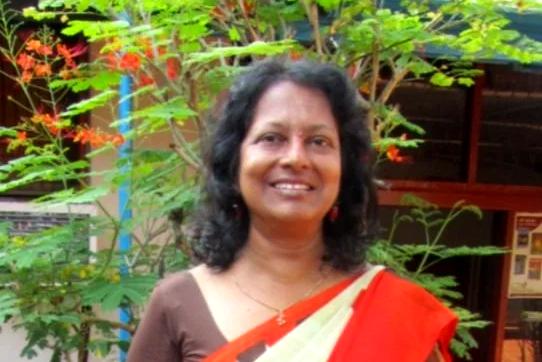
During the Sixth World Conference on Faith and Order held at St. Bishoy Monastery in Wadi El Natrun, Egypt, from October 24–28, Dr. Mano Emmanuel, head of Academic Advancement at the Colombo Theological Seminary (CTS) in Sri Lanka, spoke with China Christian Daily.
In this interview, she discusses how the seminary is spearheading curriculum revisions to address modern issues such as AI, pastoral care for Gen Z, and mental health. Dr. Emmanuel also shares insights on how "honor and shame" cultures impact interpersonal reconciliation and offers her perspective on Christian unity in a predominantly Buddhist nation.
China Christian Daily: Please introduce yourself and give our readers an overview of your work at the Colombo Theological Seminary (CTS).
Mano Emmanuel: I work at a seminary in Sri Lanka called Colombo Theological Seminary. I have worked there for over 20 years. I have served as the academic dean, but at the moment, I am the Head of Academic Advancement. I lecture in Systematic Theology, Biblical Studies, and Ethics. I worship at the Methodist Church, although I come from an Anglican background.
CTS currently serves a student body of around 200–300 individuals on our main campus. They study in three different languages up to the bachelor's degree level and in English up to the master's level. We also have eight teaching centers spread across the country, which include a couple of hundred students getting a certificate, diploma, or bachelor's depending on the center. In CTS, we also offer counseling tracks, including a Master's in Counseling and a Diploma in Counseling, which is fairly new and very popular because the need is growing.
China Christian Daily: As the head of Academic Advancement, what are your key priorities, and what new challenges is theological education in Asia facing today?
Mano Emmanuel: My key priority is spearheading a curriculum revision to ensure our theological training is relevant for the church today. Our curriculum has been in place for over 10 years, and we need to look at the changing needs of the church and see if the curriculum needs to be changed radically or slightly so that the men and women we are training will be adequately equipped to face the challenges of the next few years.
I also deal with faculty development, providing orientation for new faculty and organizing seminars for their enrichment and development.
Specifically, we are adding new focuses to address crucial challenges. This includes equipping students to deal with the moral complexities of Artificial Intelligence (AI), family and parenting, sexual ethics and gender, domestic violence, and mental health. We need to address these in the curriculum without letting go of our traditional strengths, such as systematic theology.
We are also deeply aware of the needs of the emerging generation—often called Gen Z. Much younger students are coming into the seminary—a lot of students in their 20s, whereas the average age used to be around 30. This could be a sign of hunger for knowing the truth within the church because there are a lot of "gospels" and even false teaching out there, so they want to know "what should we believe?" They are looking for somebody trustworthy to tell them why.
On the other hand, young people are less interested in being part of the institution or organization of the church. The ones coming to the seminary are very committed and sacrificial. They need grounding in truth because it's very easy for them to be drawn after experience, or by very well-known preachers, the prosperity gospel, or the contemporary Christian music scene—things that are not deep.
China Christian Daily: In what ways is theological education contributing to the development of the churches in Sri Lanka?
Mano Emmanuel: Theological education is not very old in Sri Lanka—the seminary is about 30 years old. Thirty years ago, there was a great hunger for training, but also a suspicion that if you went to a theological institution, you would lose your zeal or the power of the Holy Spirit.
Now, people understand the importance of training. By training men and women, we are helping them to think theologically and biblically, founding their churches or working in their churches with a much better foundation and grounding. Our hope is that they have the tools to face challenges without reverting to cultural ways of thinking.
China Christian Daily: Could you describe the current religious and Christian landscape in Sri Lanka?
Mano Emmanuel: Sri Lanka is a predominantly Buddhist country. Christians form about eight percent of the population, out of which only about one percent are Protestant Christians. The Catholic Church came first, due to colonization by the Portuguese, and it has the biggest proportion of Christian people.
Christianity is viewed with a certain amount of suspicion and even hostility by some Buddhist clergy because the Constitution, although it allows freedom of religion for everybody, particularly upholds and protects Buddhism. Churches, especially those that evangelize, are seen as a threat to Buddhism, and Christianity, on the whole, is seen as a foreign religion.
On the whole, there is a fairly peaceful relationship, but there have been times when Christians have been targeted, with churches burned, pastors assaulted, and anti-conversion bills promoted in parliament, though they haven't been passed. On the ground, ordinary people generally are able to live according to their faith, and the church is also seen as an organization that cares for people in times of crisis and is there to provide and help not just their people, but other people as well. The church is growing, but slowly, and the Protestant percentage remains steady at 1% although the population is increasing.
China Christian Daily: As Christians living in a Buddhist-majority country, how does the church engage with the wider community, and what unique challenges or opportunities does this context present?
Mano Emmanuel: There is some organized interfaith dialogue between the clergy. For ordinary Christians, the challenge is being able to speak about their faith with confidence. In cities and especially in Colombo, the capital, there are many very influential and better-educated Christians in many sectors, such as in education, medicine, politics, and law. However, churches are growing in some areas where people are not as educated, either. For some Buddhists, Christianity is seen as anti-intellectual since not many Christians can argue for their faith, especially in the local languages. This is a bit of a challenge. I think friendship, evangelism, and the overall good morality and ethical reputation of the church need to be upheld to be credible.
China Christian Daily: Your academic work includes the books Interpersonal Reconciliation between Christians in a Shame-Oriented Culture and Honouring God in Times of Conflict. Could you briefly introduce their main ideas and the message you hope to convey?
Mano Emmanuel: The second book is a simplified version of the first, which was my doctoral thesis. I was looking at the dynamics of an honor-shame culture, which affects interpersonal relationships.
I identified seven elements that I felt impacted reconciliation. For example, there's a tendency to desire harmony in our society; we want people to get along, but sometimes the harmony is not real shalom. It hasn't dealt with issues, but just covered up problems.
Another element is high power distance, where people in authority (pastors, teachers, parents, policemen, etc.) can't be questioned or challenged. In this kind of culture, even Christians could have two or more sets of ethical models where morality can be situational—where telling a lie is deemed acceptable if it smoothes things over, which contradicts the Bible's teaching.
My hope was that the books would be used by pastors, theological students, and missionaries to understand why some conflicts happen. It is because people are operating with two different cultures. It's also to challenge our culture to reinterpret honor and shame. For instance, confessing a wrong would be shameful in the culture, but in the Bible, it's an honorable thing.
China Christian Daily: The theme of the Sixth World Faith and Order Conference is "Where is the visible unity?" What is your personal response to the question? And what are the main obstacles to visible unity among churches today, especially in the Asian context?
Mano Emmanuel: I struggle a little bit with the term "visible unity" because, as I mentioned, sometimes what looks like visible unity is very surface-level. You could have it, but underneath the surface, there are tensions, unresolved issues, and discrimination. I believe that is not what the Bible is asking for. But on the other hand, even a superficial visible unity can sometimes lead to real shalom.
In my denomination (Methodist) and in the churches generally, I do see a fair amount of visible unity. Our church is the only Christian community that brings together people from all the ethnic groups in Sri Lanka after over 30 years of ethnic conflict. There is also unity among the mainline denominations that share a common training college. My local Methodist church welcomes preachers from many different churches, from Christian Reformed to Pentecostal. Also, as I said before in our interdenominational seminary, we have students from over 100 churches, and they share a communion service once a term. Besides, there are many parachurch organizations like Youth for Christ.
Regarding obstacles, one would be the phenomenon of independent churches, where some self-appointed pastors may even, occasionally, distance themselves from others and tell their members not to visit other churches. There is also arising false teaching arising, where people are drawn into one or two big churches that tend to be separationist because they know that the rest of the church is questioning what is being taught there. So I would say the current obstacle is not coming from persecution but lies in false teaching and could be ethnic issues in certain areas.
China Christian Daily: What message or words would you like to share with Christians in China?
Mano Emmanuel: We often hold up the Chinese church as a powerful example of God's work. When foreign missionaries left, the church did not die; instead, it grew—it's a powerful testament to how God grows His own church.
Furthermore, Chinese Christians are an example to us in facing persecution. We would want to say that we stand with those who are persecuted and pray for their strength and resilience.
Finally, the vast and rapid growth of the Chinese church highlights the critical importance of theological education. The church can grow, but I think it needs to have the teaching of the apostolic church, to be trained and teach people to receive training as well.