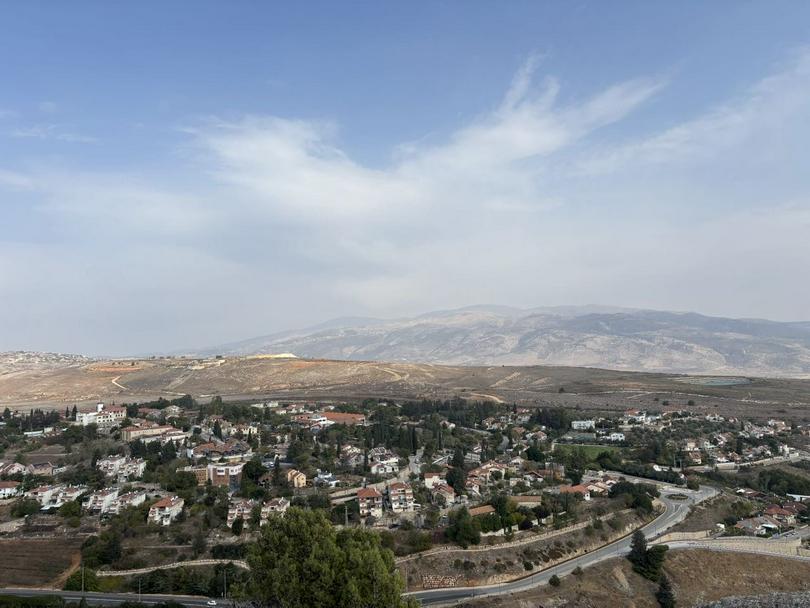
Forty percent of the some 2,000 residents in Metula, a northern town in Israel which borders Lebanon, have returned to their hometown about two years after October 7, 2023.
Ortal Israel, a 31-year-old resident who spent nearly one and a half years displaced from her home on the Lebanese border, recounted the journey from the chaos of the Israel-Palestine conflict to her determined return to a town that remains partially a ghost town during the seventh Christian Media Summit.
Hosted by the Government Press Office (GPO) in collaboration with the Ministry of Foreign Affairs and The International Fellowship of Christians and Jews (IFCJ), the summit drew more than 150 Christian journalists and influencers from over 40 countries in early November, urging for a fight against misinformation and for truth and more cooperation and solidarity with Israel.
On November 4, the participants travelled to the north of Israel to listen to the story of Ortal Israel. The latter said that her mother woke her up on October 7, 2023, just two weeks after she came back from a trip.
"We sat in front of the news the whole day," Ortal recalled. "We know this border. My bat mitzvah was during the Second Lebanon War."
Despite the danger, convincing the older generation to leave was a battle in itself. It took two days of sleeping in flak jackets before Ortal could convince her mother to evacuate. On October 9, 2023, when the whole country was under missiles and alarm, the family packed 15 people and two dogs into cars and drove to Eilat, the southernmost point of Israel, where her brother lives, dodging air raid sirens along the way.
While many of the town's evacuees remained in three hotels for months, Ortal and her mother felt a pull to return to the north. They settled in Kfar Blum, a kibbutz just over five kilometers from the border. Because of that extra distance, the kibbutz was not officially evacuated, creating a surreal existence for those who stayed.
"We were the new border of Israel," Ortal said. "It was like the Wild West. No stoplights, no shops, just us and the soldiers."
The psychological toll was heavy, particularly on the children. Ortal described how her young nephews learned to distinguish between the sound of an Iron Dome interception and a hostile missile impact as casually as other children learn to cross the street. Even they would ask Ortal, "It's ours or theirs?"
During a brief ceasefire in November 2023, the family received a call that their house in Metula had been hit. Ironically, the destruction wasn't caused by a Hezbollah missile, but by the Israel Defense Forces. A tank operating in the town had fired from near their home, and the sheer force of the backlash blew out the windows and destroyed the interior.
"The house just stood there for months—no windows, no ceiling, no doors," Ortal explained. "Rain and animals got in. It was all gone."
However, her mother's determination remained unshaken. As soon as it was remotely feasible, they began the renovation process, becoming the first house in Metula to be visited by Mas Rechush (the government property tax authority) for reconstruction. By April 2025, Ortal had moved back in. Her mother followed two months later.
Today, the physical structures of Metula are being rebuilt, but the community is struggling to recover. Ortal notes that while older residents have returned, her generation has largely moved on to Tel Aviv, finding new jobs and lives during the long evacuation.
"I was the only one in my age group here [in April]. Now we are two," she said. The local school, renovated in 2022, remains closed due to a lack of children. While other border towns see return rates of 80 to 90 percent, Metula hovers around 40 percent.
Despite the desolation and the lingering dangers, Ortal refuses to leave. Now working with the Diller Teen Fellows, a program providing young children with Jewish education, she teaches them about leadership and Zionism, embodying the very resilience she preaches.
"It is so important to me to show others that, really, it's the best place," she insisted. When asked how she can stay in a place that has seen such hardship, her answer was simple: "It's the community. The beautiful view. The best weather. When you live here, you understand."