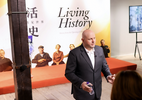
The first time I met Brother Enhui was at a large gathering, where he was serving as the host. Whenever nervousness set in, he would instinctively make a small gesture: microphone in one hand, the other reaching into his pocket for a tissue, smiling as he wiped the sweat from his forehead.
It drew warm applause from the audience. Judging by the response, many remembered this distinctive host.
Our second meeting took place on an October evening in a northern Chinese city. Sitting at a small four-person table outside a convenience store, my colleague and I listened as he shared his faith journey.
"Pockets Always Full": A Childhood Faith Fed by Biscuits
Brother Enhui's faith story is inseparable from his grandmother.
As a child, while his parents were busy running a small business, he was raised by his grandma. At the age of five or six, he often noticed her kneeling beside the bed on winter nights, eyes closed, quietly murmuring to herself. At the time, he did not understand. Looking back, he realizes she was praying.
His grandmother came to faith through her brother, whom Enhui calls his "great-uncle." After becoming a Christian, the elder man was deeply zealous—often cycling more than 20 kilometers just to visit his sister and share Scripture with her. Though Enhui's grandfather didn't follow the faith, he lived by a code of "conscience and kindness." Whenever a beggar came to their village, his grandfather never sent them away empty-handed. Believing that faith in Jesus encouraged such goodness, he never stood in the grandmother's way.
In time, his grandmother became a regular churchgoer, and young Enhui was always brought along. At church, some women found the little Enhui adorable and quietly slipped him biscuits. To avoid disrupting the main service, church workers gathered the children in another room, where they played games and answered questions—each correct answer earning a biscuit.
"How many persons are there in God?"
"Three."
"Who?"
"The Father, the Son, and the Holy Spirit."
One biscuit.
"Where does the Holy Spirit live?"
"In our hearts."
Another biscuit.
"I was always the first to answer," Enhui recalled proudly. Each time he returned home from church, his pockets were full. Back in the village, children would immediately gather around him, and he would share the biscuits. "It felt very rewarding," he said.
In many ways, his childhood was quite literally "fed" by church biscuits.
Leaving Faith—and Returning Through Tears
During middle and high school, influenced by materialist thinking, Enhui gradually drifted away from faith. He frequently debated with his grandmother, who could not persuade him and could only pray for him in tears.
The turning point came during his university years.
One of his roommates was a Christian with remarkable zeal—going door to door in the dormitory to ask if anyone believed, then singing hymns with a guitar in the room. More often than not, he was met with ridicule or verbal abuse. Enhui was among those who mocked him.
When faith came up in conversation, Enhui explained that he had believed as a child but no longer did, insisting that he now held to materialism. This led to repeated "debates": one arguing materialist philosophy, the other sharing the gospel, each speaking for half an hour, trying to outdo the other.
University life was relaxed, and Enhui often skipped classes to sleep in. On many mornings, the Christian roommate would sit beside his bed and sing hymns with his guitar.
At first, Enhui felt nothing. But one day, when the song "Lord, You Are My Closest Friend" was sung, tears suddenly streamed down his face.
"I grew up hearing my grandmother sing this hymn," he recalled. "She didn't know any others—just this one."
Memories resurfaced: biscuits from Sunday school, winter nights when his grandmother was still reading the Bible late into the night. Soon after, he began attending church with his roommate and was baptized the following year.
Serving Through a Changed Life: A "Life-Building Project"
After graduation, Brother Enhui entered the work field. Not long afterward, at an evangelistic meeting led by Stephen Tong, a renowned Chinese Indonesian Reformed evangelist, he went forward in tears, offering himself fully to God and beginning his journey in ministry.
Strongly influenced by Reformed theology, he later became aware of his own struggles—"easily drawn into conflict" and "communicating with an edge," as he put it. Realizing that something was wrong with his spiritual life, he committed himself to his current church.
There, he encountered a pastor marked by gentleness and fatherly care. Brother Enhui often listened to recordings of the pastor's sermons as he went to sleep and, over time, experienced significant spiritual growth and life transformation. Though the pastor was not much older than him, Enhui always referred to him as "father." When the pastor was recently reassigned to another city, Enhui wept at the farewell—"as if losing a father."
Where people are healed, they often become instruments of healing. Like a cracked jar holding treasure, light shines through the fractures, illuminating the path for others.
"Watching believers move from new faith to zeal to lives being shaped and built up," Enhui said, "that transformation—that is a life-building project," describing the motivation and purpose behind his service.
He often recalls a line from the hymn "Miracle": "O God, I want to serve You, with my life transformed."
Looking back, Brother Enhui has come to a deeper understanding of divine election. The seed of the gospel was planted in his childhood by his grandmother. No matter how winding the journey, that seed would one day take root again—growing quietly, faithfully, into new life.
Originally published by the Christian Times
- Edited by Poppy Chan