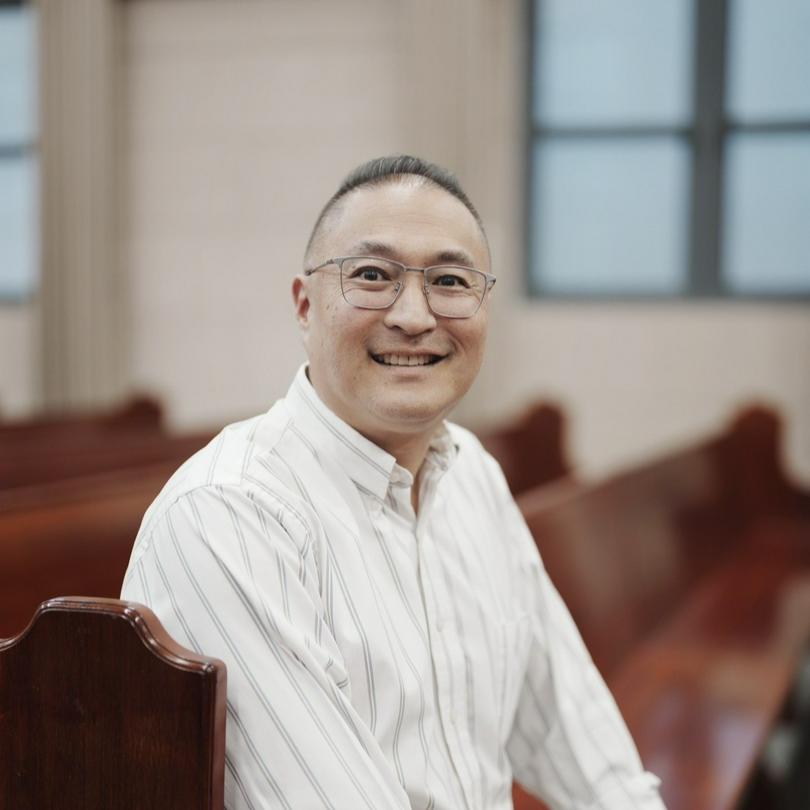
For Pastor Jason Kim, the journey to Shanghai was never meant to be a marathon. When he first arrived in the winter of 2007 with his wife and daughter, the plan was simple: survive one year, claim the experience, and return to the familiar comforts of the United States. He did not know the language, he did not know the culture, and he certainly did not expect to stay.
Eighteen years later, he is still there.
"The heart of man plans his way, but the Lord establishes his steps," Jason told China Christian Daily, quoting Proverbs 16:9, a verse that has become the anthem of his life in China. As the senior pastor of Thanksgiving English Fellowship (TEF), located in the bustling Zhangjiang High-Tech Park of Shanghai's Pudong district, also known as China's "Silicon Valley," he has witnessed nearly two decades of rapid transformation—both in the city's skyline and in the spiritual lives of his congregation.
A Vision Beyond Technology
The origins of the fellowship are inextricably linked to the rise of Shanghai's tech industry in the early 2000s. The initial spark can be traced back to Richard Chang, founder of Semiconductor Manufacturing International Corporation (SMIC). While Chang is best known for establishing what is now China's largest chip manufacturer, Pastor Jason recalled that the founder had a broader three-fold vision to help the region "technologically, educationally, and then the third part spiritually."
This vision set in motion a unique ecosystem in Zhangjiang: the founding of the SMIC company in 2000, the SMIC Private School in 2001, and the initiation of the Thanksgiving Church in 2006.
Jason, who had been serving at the Chinese Independent Baptist Church in Oakland, California—the second-oldest Chinese church in North America—initially rejected the invitation to move to Shanghai. "I was born and raised in America. I've never lived outside of the United States," he recalled telling Chang. However, after a visit to speak at a youth camp of the Thanksgiving Church in 2006, Jason and his wife felt a tug toward the needs of the growing international community in Pudong.
They arrived in Christmas of 2007 to spearhead the English ministry. In those early years, the connection between the company and the church was tight. To secure a visa, Jason spent his first seven years working a dual role: serving as a pastor on weekends and working in Human Resources for SMIC on Tuesdays and Thursdays, conducting training for a workforce of 17,000 people.
Adapting to a Unique Ecosystem
Today, the landscape has changed. The company, the school, and the church now operate independently. TEF now navigates a unique existence: legally a ministry under the local Thanksgiving Church, but functioning autonomously. Jason describes the relationship as cordial, retaining a spirit of Christian connection.
In earlier years, the two groups united for charity initiatives, such as clothing drives to support the homeless. While those joint ministries have quieted in recent times, a spirit of mutual respect endures—marked by shared Christmas gifts and a shared roof.
TEF stands as one of the five public international churches in Shanghai. While situated in a high-tech park, the congregation has evolved from being almost exclusively SMIC employees to a diverse body of professionals. Today, the church has about 300 attendees, down from around 500 before the pandemic, including doctors, engineers, teachers, and other professionals. It is a multigenerational body, split evenly between youth and students, young adults, as well as families and professionals.
The demographic face of the church has also shifted significantly since the pandemic. Prior to COVID-19, the congregation had a larger presence of Western expatriates. Today, reflecting the broader trend in Shanghai's international community, the pews are filled with more "local hires" and Asian expatriates from Hong Kong, Taiwan, and South Korea, alongside a recent increase in attendees from Russia and Eastern Europe.
Shepherding in a "Narnia" Pace
Ministering to such a diverse group in a quick-paced city requires adapting to what Jason calls "Shanghai speed." He likens the experience to C.S. Lewis's Chronicles of Narnia, where time moves differently.
In the story, one year in London was like hundreds of years in Narnia, he explains. "That's what it feels like doing international church ministry. Things that took me five years to do in an American church take one year here because things move so fast."
This acceleration is driven by high mobility. The church sees a constant turnover of congregants, typically every three to five years, as expatriates move for work or return home. "If you are part of TEF for two years, you're already a senior member," Jason said. This fluidity forces the church to be in a constant state of "reinventing" itself, perpetually training new leaders to replace those who leave.
Beyond the turnover, the congregation faces the intense pressure notorious in first-tier Chinese cities. To support those struggling with work stress, personal crises, or burnout, the church established a "Stephen Ministry." This specialized program equips laypeople with 50 hours of training to provide one-on-one, confidential care to those going through difficult seasons.
"I am only one person," Jason noted. But with 25 active Stephen Ministers, the church can offer personalized support that a single pastor cannot. "Probably more than 75% of our church has utilized this ministry in one fashion or another."
Salt, Light, and the "Thousand Countries"
Despite the challenges of a transient flock and the pressures of life in a global metropolis, the ministry thrives on a deep hunger for truth. "People in China in general... are often very hungry for the truth," Jason observes. Unlike in the West, where religious freedom is common but church attendance is declining, he finds that the environment in China often makes people more curious about faith.
He reminds foreign observers that China is too complex to generalize. "China is not one country. China is like a thousand countries," he says, emphasizing that the environment in Pudong differs vastly from other regions. "Whatever you hear about China is true in some places in China, but not everywhere in China."
This hunger drives the church's emphasis on the Great Commission. Jason preaches that believers remain in the city not merely for career advancement, but to be "salt and light." He challenges congregants to embody their faith through integrity—being an ethical boss or a diligent employee—in a marketplace where cutting corners can be common. "The one thing we will never be able to do in heaven is evangelize the lost," he reminds them. "That is why we are still here."
No Regrets
Looking back on his 18 years, Jason shares a lighthearted anecdote. When he arrived in 2007, he was offered a chance to purchase an apartment in the living quarters, Zhongxin Huayuan, for a mere 5,000 RMB per square meter—provided he signed a five-year contract. Convinced he wouldn't last that long, he declined.
"Today, it's worth a lot more money," he laughed. "I do regret not buying it!"
"It taught me that the biggest regrets in life are not just the bad things we do, but saying 'no' to the good things." While he missed a real estate windfall, he gained something far more valuable. "I'm so grateful that I don't regret saying no to China. I'm so glad that I said yes."
As Christmas approaches, the church is preparing for a celebration focused on the essentials of the faith. On the Sunday before Christmas, TEF will host a Christmas service featuring 13 baptisms.
"You're not going to hear people singing 'Jingle Bells' in our church," Jason said. "All the songs will be geared toward Christ. Jesus is the reason for the season."
For Pastor Jason, Shanghai has transitioned from a temporary stopover to a place he deeply loves. In his interactions with local government officials, whom he meets with respectfully each year, his message remains consistent: "I want you to know two things about me. One is I love Jesus. And number two is I love China. This is my home now."