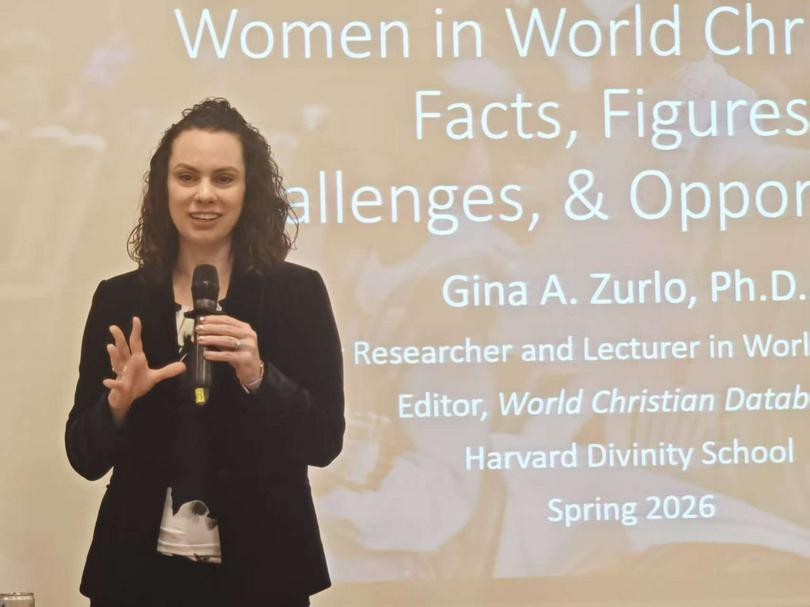
Addressing the stark contrast between female participation and leadership in the global church, Dr. Gina A. Zurlo delivered a lecture titled "Women in World Christianity" on March 9 at the Divinity School of Chung Chi College, The Chinese University of Hong Kong.
Dr. Zurlo, senior researcher and lecturer on world Christianity at Harvard Divinity School and editor of the World Christian Database, challenged the "data gaps" that often leave women's contributions invisible, arguing that while women are the majority of the world's Christians, they remain significantly underrepresented in leadership, participation, and physical security.
Data Gaps and Methodology
Dr. Zurlo began by detailing global gender disparities, the chronic lack of church data on women, and specific gaps in church membership, participation, and leadership. She explained that churches often fail to collect or report gender-disaggregated data, leading to official statistics that don't match qualitative evidence of female-majority congregations.
To combat this, Dr. Zurlo's team triangulates government censuses, denominational reports, and crucial on-the-ground research. As a case in point, she described a multi-year effort in Nepal in which her team's estimate of the Christian population (4.6%) differed from both government (1.3%) and local church reports (2.3%) following a detailed analysis of the methodologies used. Acknowledging the difficulty, Dr. Zurlo said she plans to add reliability ratings to the database to reflect data confidence better, noting that a country like China remains a "black box for researchers." Her small team is now developing a custom AI model to help accelerate this complex data collection.
A survey on congregational life conducted by Dr. Zurlo further revealed a disconnect between perception and reality. While respondents often believed men and women had an equal chance at many church roles, the data showed a stark divide. Women were predominantly found in roles like administrative assistant and children's Sunday school teacher, while men dominated senior pastoral and leadership positions.
The Leadership Gap
The most significant disparity appeared in leadership. According to Dr. Zurlo's research, men can serve as pastors and on decision-making bodies in 100% of the churches studied. While women can serve on decision-making bodies in churches representing 84% of global Christians, only 45% of Christians belong to denominations that permit female pastors.
"Men rarely or ever have to ask, 'What are they allowed to do in this church?' Women are constantly asking, 'What are they allowed to do?'" Dr. Zurlo added, "Men can say, 'What am I called to do,' but women have to say, 'What am I called to do and what am I allowed to do?'"
Counterintuitively, the potential for female pastoral leadership is higher in the Global South than in the North. Dr. Zurlo's data shows 55% of Christians in Africa and 70% in the Caribbean worship in churches that allow female pastors. This is compared to lower figures in Europe, where the Catholic and Orthodox churches, which do not ordain women, are concentrated. Asia had the lowest figure, at 12%.
A Call for 'Genuine Mutuality'
Looking forward, Dr. Zurlo shared that her next research project was directly inspired by feedback from ordained female ministers in Fiji. They told her that ordination, while a milestone, was ultimately "performative" and "not enough" and that they wanted the ability to reach the "very top" of church structures.
To conclude her presentation, Dr. Zurlo offered a theological framework for addressing such challenges, rooted in the principle of "genuine mutuality." She clarified the goal is not "reverse discrimination" but a community where "each [is] participating according to their gifts."
Crucially, Dr. Zurlo stressed that applying this principle must be context-specific, rejecting a one-size-fits-all Western feminist model. "Feminism is about choice," she stated, a principle that equally validates the Fijian women's desire for top leadership and the different priorities of women in other cultural settings.
Achieving this mutuality, she added, requires men to actively participate in shifting social norms, such as by serving in traditionally female-held roles in the church. The ultimate goal, Dr. Zurlo argued, benefits the entire community. Citing the African concept of Ubuntu, she concluded, "'I am because we are. 'We need everyone."