In late October, the Sixth World Conference on Faith and Order was held in Wadi El Natrun, Egypt. I had the privilege to attend as a media representative.
This was my first time attending a global Christian conference. From the setting in African Egypt to the theological debates in the schedule, from interactions with theologians and pastors of diverse backgrounds during breaks and banquets to the visits to Coptic Orthodox monasteries—everything offered an intense sense of freshness.
Much like the American writer Peter Hessler in Fuling (River Town), Chongqing, who adopted an outsider's perspective to discover the strangeness and wonder that locals often miss in their "ordinary lives," World Christianity rushed toward me—an "outsider"—in a wondrously condensed way. It refreshed my understanding: So this is what Christianity looks like outside of China; these are their current concerns; and this, it turns out, is how they view the Chinese church.
A Colorful Spectrum of Global Faith
At the World Conference, denomination is a crucial marker of identity.
The organizer, the World Council of Churches (WCC), maintains a tradition of morning and evening spirituality. Before the day begins and after it ends, morning and evening prayers are held using hymns and liturgies from different regions and denominations.
In the context of faith life in China, these "prayers" felt more like formal Sunday services. The flow included praise, choir anthems, scripture reading, and a sermon or reflection. The prayer section used specific liturgical texts: the leader recited, and the congregation responded with fixed phrases.
After the first morning prayer, the leader asked us to greet one another according to our own traditions. Some made the sign of the cross; others placed their right hand over their heart and bowed; some kissed the back of their hand; and others simply shook hands, all accompanied by unique greetings. One girl bowed halfway toward me. In that moment of eye contact, I was momentarily at a loss—what etiquette should I use to respond? My home church does not have these traditions. This was my first encounter with "denomination" at the conference.
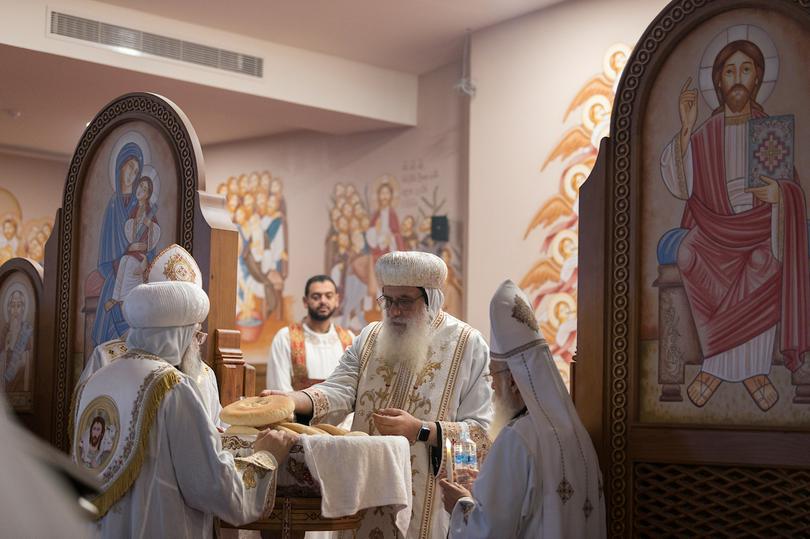
Attire was another distinct marker. At the opening ceremony, ethnicity and denomination were easily identifiable. Bishops from Catholic, Eastern Orthodox, Coptic, and Lutheran traditions wore black, purple, or red robes—some with small red skullcaps and rounded collars, others with heavy black cylindrical hats. Attendees from Africa, India, Malaysia, and Indonesia were easily recognized by the cuts and patterns of their clothes. Meanwhile, delegates from China, Korea, and Japan, often dressed in Western business suits, were frequently mistaken for one another.
The atmosphere differed vastly between high-church traditions and emerging churches. Speaking from a lay impression, the hymns of the Coptic and Eastern Orthodox churches carried a historical halo—repetitive chanting of simple lyrics created a solemn, ancient, and low-key atmosphere. In contrast, the music from the Australian Pentecostal delegates was modern, lively, and fun; the choir didn't stand rigidly but swayed naturally with the music.
Regardless of the occasion, African brothers and sisters could transform the atmosphere with just a few lines of song. They would dance as if no one were watching, and when fully immersed, they might add a long section of rap as a fitting response. Perhaps the tropical sun bestows a natural gift for freedom.
At a special dinner hosted by the Coptic Orthodox Church featuring a famous local band at the Anaphora Retreat Center on Sunday, I sat with three brothers from Brazil. After three rounds of songs, we shared the same question: Why are they singing the same music three times? The songs must have changed, but to our ears, the subtle variations in Egyptian language and melody were perhaps too understated.
During the conference, a Brazilian pastor remarked that the Brazilian church has one of the largest LGBTQ populations in the world. The pride in his expression and the matter-of-fact manner in which he spoke of advocating for sexual minorities were surprising to me. The three Brazilian brothers at my table, however, were more concerned about social polarization and the tightening relationship between the Catholic Church and the government, fearing the use of state power to exclude other denominations.
The rise of India was another surprising fact. Indian participants were visible everywhere—moderating sessions, speaking at lectures, and leading workshops. A pastor from Northern India told me that Christians are present in significant numbers across India, now exceeding two percent of the total population. Their engagement in international Christian conferences is climbing steadily.
The Catholic and Orthodox churches occupy a significant position on the map of World Christianity. In China, when people mention Christianity, most think of Protestants; Catholics are a smaller group, and the Orthodox Church seems to exist only in tourist spots in Harbin. But outside of China, the Catholic Church holds the most believers, followed by Protestants.
At this conference, despite divisions and disagreements, one could still feel the natural pride of the Catholic and Orthodox churches when discussing Apostolic Succession—maintaining the apostolicity and catholicity from the early church to the present, combined with the episcopal system, liturgy, and tradition. Their identification with tradition—and a subtle condemnation of the "chaos" of "interpretation outside of tradition"—allowed me to feel the tension of the Reformation era, even centuries later. Given some phenomena in churches in recent years, even I, a Protestant from China, felt that, within certain boundaries, their arguments were not without merit.
The Paradox and Harmony of the Coptic Orthodox Church
The monastery was so vast that even my phone's wide-angle lens couldn't capture it all.
On the third day, we visited four Coptic monasteries. The high walls stretched beyond sight in the Monastery of Saint Macarius the Great. Unlike the monasteries imagined by ordinary believers, this place resembled a fortress—indistinguishable from the fortress models exhibited in the Egyptian Museum.
The monastery housed over two hundred monks who farmed mangoes and other crops for sustenance. The central church buildings date back to the seventh and 12th centuries. Located in the desert, it was scorching hot outside, but distinctly cool inside the church. Because the desert offers no cover, the monastery walls were built up to two meters thick to defend against bandits or attacks. When enemies struck, monks could hide inside with food and water for months.
The walls of the church were painted with biblical stories and the famous monks. Some had faded, leaving only faint white or black patches that required explanation to decipher. Newly restored frescoes, however, were exquisitely beautiful. The artists favored blue, gold, and red—rich blocks of color and fluid lines covering the entire church. The carpets and chair covers, woven with unique craftsmanship, blended seamlessly with the murals. Sitting there, looking up, down, left, and right, one saw only holy icons. Directly in front, the Father opened His arms to the universe.
The Coptic Orthodox Church, a "minority denomination" that often appears in the news alongside persecution and martyrdom, possesses a "magnificence" unknown to many Christians—much like these monasteries. His Grace Bishop Kyrillos, a Coptic Bishop of Los Angeles, spoke of his church's tradition and influence in Egyptian society with overflowing pride.
This bishop, the first American citizen to become a Coptic bishop, is Egyptian by birth but grew up in the US. He speaks fluent English but is less proficient in Arabic, often serving as the church's spokesperson for external affairs. He observed that while many churches are losing young people, the Coptic Church is growing. Part of the reason lies in the Coptic spiritual tradition: rising at 4 a.m. every day, and aside from labor and meals, devoting all time to contemplation and prayer. This tradition is attracting the youth.
In the desert, the setting sun dyed the walls red. Looking at the wooden cross, I felt the call of this spirituality. Compared to the flesh, the inner life, consciousness, and soul possess an incomparable reality.
Like other Coptic bishops, he wore a thick white beard, yet his speech carried the casual flexibility of California. As he spoke, he unconsciously stroked his beard, and an Apple Watch would peek out from his black robes.
As young people from various places join, the Coptic habit of early rising is changing—young people are more accustomed to praying late at night and sleeping in the morning. He views this with optimism, seeing no issue.
The asceticism found in Christian history textbooks also left traces in the architecture. Beyond the towering roofs and ornate frescoes, there was a small, low-slung flat cell house in the courtyard. The cave-like entrance allowed only one person to enter by bending low. The "antechamber" fit three people turning around; the left wall had two carved niches for Bibles and other scrolls. Bending again to go deeper, one entered a space where only one person could fit, sitting on a mat on the ground. Four walls, no light, nothing else.
This low room—or more accurately, a hole—was easier for hiding from enemies on horseback, but for most of the time, it was where monks learned humility. Locals said that historically, monks lived in nearby caves and only came to the monastery church for services.
Daily, traveling between the hotel and the conference venue, I would see men in pale green robes. They looked like monks, though their collars were not slanted. These were modern monastics.
Coptic believers express respect and blessing by kissing the right hand. Many young families visited the monastery. Even children still held in arms would reach out to touch ancient books, the banners embroidered with saints, or even the walls, and then bring their own hands to their lips. When priests or bishops in black robes passed by, believers would unexpectedly grab their right hands to kiss them. The clergy would swiftly retract their hands. It inexplicably reminded me of the hem of Jesus' garment—as long as there was contact, power and blessing would flow out.
At the conference, bishops often showed similar reverence to His Holiness Pope Tawadros II. The Pope held a golden staff; when he entered, the entire assembly stood spontaneously. Before speaking, he extended his right hand and pressed it downward, signaling everyone to sit.
Like a king, he sat in the center of the first row, watching the speakers on stage, with no one behind him. After the opening ceremony, pastors from the Anglican and Presbyterian churches in Egypt went up to greet him, kissing his right hand with the humility of respecting an elder.
It felt strange to me. But as we were leaving after a group photo, he suddenly looked back. In that brief eye contact, perhaps due to the atmosphere, I suddenly felt a sense of being seen.
A Proud Middle East
Christianity is not a Western religion; it is an Eastern one. It originated in the Middle East and boasts a dazzling history there. When Christians from Egypt, Pakistan, Lebanon, Iran, and Iraq speak of their local faith, what they most want the world to remember is not their suffering or persecution, but that Christianity grew from this very soil.
"Our faith is to serve the poor and the marginalized, not the rich and the powerful." These words from a professor at the Near East School of Theology in Lebanon were deeply thought-provoking. Somehow, world Christianity today seems constantly in pursuit of data, using capitalist tools to measure church development. But in the Middle East, amidst persecution, faith retains some of its primordial characteristics.
For them, the question of faith must be answered with one's life. Their conscience constantly asks: Should I trade the sincerity of my faith for a chance at survival?
We hear that they suffer persecution, but we often do not realize that many families endure exile due to oppression by extremist groups. Yet, as this professor said, living with vulnerability in one's homeland—this weakness, rather than strength or power—is the original face of faith shown to us by the Incarnate Jesus.
Language, Action, and the Sound of Silence
A key agenda of the conference was the "consensus" session for the final document: forming a call to action representing the meeting's message, aligned with the views of all participating churches.
Objections were plentiful, though rarely about fundamental principles. Most were about weighing words. For instance, a suggestion was made that "Jesus told his disciples" should include the definite article "the"—"told the disciples"—to specifically denote the twelve.
The line for suggestions was long. At first, it seemed novel, but gradually it felt like nitpicking over trivial details. Is this necessary? Unlike me, most participants clearly felt it was: since the document would be released in the name of all participating churches, they had to ensure their views were "correctly represented."
A single word difference pointed to the specific concerns of these churches: African Christians requested changes to any phrasing with tendencies toward racial discrimination; Indonesian theological students wanted to add concerns about ecology, specifically ocean and island protection; pastors focused on gender equality demanded additions regarding gender issues; Australian representatives insisted on highlighting the appeals of Maori and indigenous believers.
You may think it doesn't matter, but it matters to me, and I must say it. This attitude was thought-provoking.
Regardless, the debate was heated. But it was glaringly obvious that East Asia was voiceless.
Does the world's advocacy already perfectly represent us? Or have we simply not yet discovered what is unique to us—what must be known and faced by the world?
Behind their determination to speak is the belief that language, expression, and advocacy have meaning. In contrast to words, the Chinese pastors I have met tend to prioritize tangible action. Compared to discussing concepts, they care more about whether today's visitations were assigned or if tomorrow's fire safety inspection is prepared. In recent years, they have become even more silent.
Compared to the attitude displayed at this World Conference, people in my context increasingly disbelieve that speaking out or expressing oneself serves any purpose. "All talk and no action" is shameful, but we need not swing to the other extreme and devalue the importance of "speaking." After all, our faith is ultimately a faith of the Word that became flesh. But before the Word becomes flesh (action), the Word must first be spoken.
How the World Sees the Chinese Church
When interacting with representatives from Europe, the US, Latin America, Africa, and Southeast Asia, their reaction to my being from China was highly consistent: astonishment. In their opinion, attending a world conference from the "persecuted Chinese church" must be incredibly difficult.
At the same time, they marveled at the rapid growth of the Chinese church, praising the faithfulness and endurance of believers. Even when informed that official data suggests nearly 40 million believers, they noted that while the number is vast, it remains less than 1% of the population, making it a minority group.
Unexpectedly, even bishops and theologians from Egypt, Indonesia, India, and Sri Lanka felt the Chinese church was in "deeper waters" than their own. This psychological discrepancy might stem from my own stereotypes about their situations, but also because they use a different standard to measure hardship—and by that standard, China's environment seems more severe. Of course, this also stems from the lack of a comprehensive, authentic portrayal of the Chinese church on the global stage.
Furthermore, a Sri Lankan professor of systematic theology and ethics shared her perception, specifically noting that the Chinese church lacks foundational training. She suggested that church leaders need to strengthen their own training while teaching believers to accept training.
"Post-denominational" was another impression held by other delegates, especially the WCC. In the ecumenical movement, much resistance to unity comes from different denominations holding fast to their specific traditions of faith and order. Achieving unity amidst divergence is the WCC's vision. The Chinese church, with its massive congregation, has largely entered a non-denominational or post-denominational stage. In terms of unity—at least denominational unity—this is something they admire.
In the reality of denominational diversity, this conference showed newer churches—from the Global South, indigenous groups, Pentecostals—actively expressing their unique experiences. Amidst the tension between tradition and modernity, the traditional Christian denominations displayed humility. This was especially true of the WCC General Secretary and the Moderator of the Faith and Order Commission, who showed deep respect for the contexts of every nation and sect.
Before stepping out of one's own country, people tend to feel their nation is the center of the world. This is true for China, for Brazil, for the US, and for Egypt. Maps are always drawn with one's own country in the center.
How do we step out of egocentrism to respect and understand the local contexts of other churches? The participants of this conference showed me that only under the same faith, within the gospel, can those who hold power and voice take the initiative to bow their heads and humble themselves. And only then can those who are self-centered step out of themselves to understand one another and achieve unity.
Originally published by the Gospel Times
- Edited by Katherine Guo