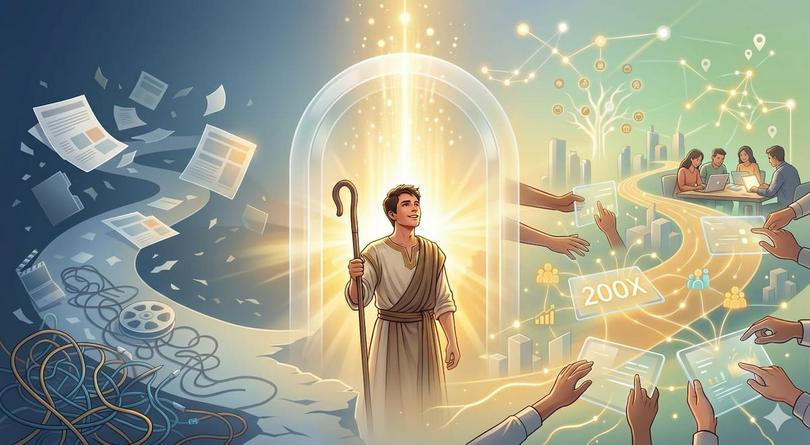
A "digital missionary" who has long been creating Christian content was initially highly skeptical of artificial intelligence (AI). However, an experience using AI to create images changed his opinion of it, and he began to reconsider its potential. Gradually, he started applying AI in church ministry and was later invited to share practical AI applications in different cities.
At the beginning of 2023, when ChatGPT had just been released, Brother Thomas's first reaction was doubt.
A few months later, one of his close friends introduced him to AI tools and especially encouraged him to give them a try.
It was when he first used the AI art tool Midjourney. Randomly, he selected an article he had previously published about the Christian perspective on work. The writing was plain, the content rather dull, and it had only received a little over 300 views. He selected one sentence from the article and gave it as a prompt to the AI tool. A few seconds later, an image appeared. It was a young man holding a staff, chin lifted upward, eyes gazing toward the sky, a faint smile on his lips, while golden paper fragments drifted down from above. The image symbolically expressed the meaning of the sentence: "Ordinary work is a God-given calling."
Next, he created seven or eight more images, paired them with texts, and reposted the content in a visual format. The view count quickly surpassed 6,000.
Thomas comes from Northwestern China and has a quiet, restrained character. "I wanted to work for the salvation of souls. Even if it meant taking a low-paying job in a church making and presenting PowerPoint slides, I would still be willing," he prayed before graduating from university.
Later, he began using digital content such as articles, videos, and other media to organize, edit, and format materials that communicated the gospel. He posted them on social media. His ministry continued for ten years.
This kind of ministry has a vivid name, "digital missionary." These individuals use their technical skills, creativity, innovation, and flexible forms of content to pioneer the digital frontier, becoming ministers for the digital age.
But problems gradually emerged. The amount of content that needed to be produced kept increasing. The working pace kept accelerating, and especially in recent years, changing environments have made publishing digital content increasingly difficult. Content based on faith values often had to be revised repeatedly before it could finally be posted successfully.
Yet revisions almost always meant starting over from scratch, which could take at least two or three days. The more rework required, the greater the exhaustion. He reflected, "Back then, much of the content was secondary processing. It involved organizing, optimizing, and restructuring. Yet it wasn't true creation from zero."
He discovered that AI did not simply provide answers. Instead, it first gathered and organized large amounts of information from related articles, background materials, and different perspectives, then extracted key points, and finally produced a clearly structured output. This process felt very familiar to Brother Thomas.
At that moment, his judgment about AI changed. In the past, if a piece of content needed modification, they would often abandon it altogether because the cost of revision was too high. But now, he could revise content through "conversation" that is feeding the content into AI and giving clear instructions, receiving multiple revised versions within a minute. Through repeated interactions, the AI even became more capable of "understanding human intent."
A year ago, ChatGPT-4o introduced its latest image-generation features. Thomas chose stories from the Holy Week and the resurrection of Jesus, combining them with the then-popular Studio Ghibli-inspired illustration style to create accompanying artwork.
One of the "Good Friday" series consisted of twelve images: Peter weeping bitterly after the rooster crowed, Judas throwing down the money bag and walking away with his head lowered, and Jesus standing trial before Pilate, etc. The characters, settings, facial expressions, and even the clothing were depicted in careful detail.
"At that time, I felt this was a transformation moment, a milestone moment. I received tremendous encouragement from readers on the platform," he said, "This is the correct way to use AI."
In the second half of last year, as Thanksgiving and Christmas approached, he began another round of video creation. Although the finished videos were often less than two minutes long, they sometimes required all-night work sessions.
During Easter 2026, he experimented with a new minimalist illustration style and once again received high traffic and positive feedback.
Starting in the second half of 2025, he also began working as an AI trainer. The collaboration began unexpectedly. During a training session, Thomas met a Christian sister who ran a training company. She noticed that his PowerPoint presentations were simple, clear, and highly user-friendly. Her company specialized in professional leadership training and team-building programs, which required producing large numbers of polished presentations. At first, she simply asked Thomas to redesign an internal company presentation. Using AI tools, he quickly created several draft versions, and they were satisfied.
Later, Thomas suggested that instead of depending on him, it would be better to teach people how to use AI tools themselves, because the real key was learning how to create such presentations independently.
The next day, he played the role of a trainer for the first time. From then, the AI training work has continued until now.
In January 2026, he attended a leadership training program. However, one participant shared a financial presentation that attracted widespread attention, and that presentation had been created by using AI tools under his training. The conference organizer immediately decided to add a one-hour AI training session for him.
During the following week, Thomas continuously organized his experiences and reflections about AI. Between classes, breaks, and meals, he turned his understanding of the AI era—its background, transformation, applications, and case studies—into diagrams and then generated presentation slides page by page.
After his presentation, many pastors and ministry workers at the conference expressed how their previous views about AI had been completely renewed. That evening, an additional hands-on AI workshop was added. The class was constantly interrupted by questions, and he responded to them all.
"This became the second section of the training, practical application," Thomas explained.
Afterward, cities in different regions began inviting him to conduct AI training. At one training session with more than 40 participants, only a few people had any prior understanding of AI. This made him realize for the first time that what he considered "common knowledge" was still completely unfamiliar to many others. "I was very surprised. Many people's understanding of AI was limited to DeepSeek," he said. As a result, he began teaching more slowly and in greater detail.
As the number of AI training sessions increased, he often found himself traveling between cities. While riding high-speed trains, he would continually share his ideas with AI, generate prompts, and then feed them into image-generation tools. By the time the train was about to arrive, an updated version of his AI training presentation would already be finished.
"Our God is doing something new. The birth of each new technology is never accidental," he said. "God has never intended for us to live, work, and minister using only old methods and past experiences. Since we believe God is the Creator of all things, sovereignty over new technology also belongs to God. We must learn to use it wisely and discover the right ways to use it in serving the church."
("Brother Thomas" is used as a pseudonym for safety reasons.)
- Translated by Charlie Li