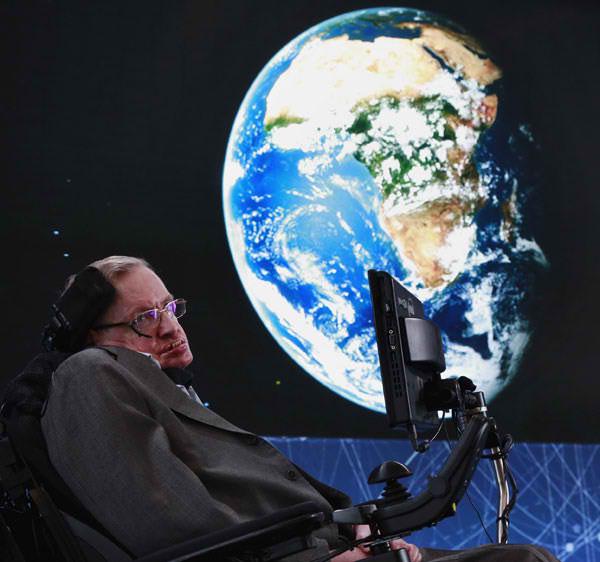
Stephen Hawking (1942–2018) passed away last year, but his ideas remain a significant cultural influence. Renowned for his views about science, he also made many comments about God. When he claimed in 2010 that there is no need for God in order to explain where the universe came from, his eminent colleague at Cambridge University, the Astronomer Royal Martin Rees, remarked, "I know Stephen Hawking well enough to know that he has read very little philosophy and even less theology, so I don't think we should attach any weight to his views on this topic."
In his final book, Brief Answers to the Big Questions, published posthumously after his death, Hawking evinced the same ignorance about philosophy and theology when he tried to explain why he thought that "the simplest explanation is that there is no God." No one created the universe, and no one directs our fate. This leads me to a profound realization: there is probably no heaven or afterlife either.
He made the astonishing claim that "the laws of nature itself tell us that not only could the universe have popped into existence without any assistance, like a proton, and have required nothing in terms of energy, but also that it is possible that nothing caused the Big Bang. Nothing."
What made Hawking think that the laws of nature tell us that it is possible that nothing caused the Big Bang? He began by claiming that "when the Big Bang produced a massive amount of positive energy, it simultaneously produced the same amount of negative energy. In this way, the positive and the negative add up to zero, always. It's another law of nature."
However, the claim that the positive and negative energy add up to zero does not imply that the positive and negative energy began to exist uncaused. Consider this analogy: the fact that my company's total expenses cancel the total revenue, such that the net profit is zero, does not imply that the expenses and revenue occurred uncaused! We still need to ask what made the expenses and revenue be the way they are. This analogy highlights the fallacy of "net zero imply no cause." One can still ask if there is any cause that made the energy and the laws of nature to be the way they are.
Hawking also claimed that at the subatomic level, "conjuring something out of nothing is possible. At least, for a short while. That's because, at this scale, particles such as protons behave according to the laws of nature we call quantum mechanics. And they really can appear at random, stick around for a while, and then vanish again, to reappear somewhere else."
However, he failed to mention that quantum particles do not come into existence from absolutely nothing; rather, quantum particles are manifestations of pre-existent quantum fields that act according to pre-existent quantum laws.
Hawking seemed to have anticipated the above problems when he asked, "But of course the critical question is raised again: did God create the quantum laws that allowed the Big Bang to occur?" He went on to claim that there cannot be a Creator who made the energy and the laws of nature to be the way they are, because
"You can't get to a time before the Big Bang because there was no time before the Big Bang. We have finally found something that doesn't have a cause, because there was no time for a cause to exist in. For me this means that there is no possibility of a creator, because there is no time for a creator to have existed in."
But why does God need to exist in time? Hawking's statement begs the question against a transcendent Timeless Creator who can exist outside of time and reveals an ignorance of the writings of many philosophers and theologians throughout history who have argued that there is such a Creator God. Moreover, it also reveals an ignorance of the problem of saying that an event (the Big Bang) begins to exist uncaused.
Think about why it is the case that you are reading this now rather than (say) sleeping. The answer is simple: something caused it to happen. However, if an event begins uncaused, then there would not be any cause, which would make it the case that only this event rather than other kinds of events begins to exist uncaused. Likewise, if the universe begins to exist uncaused at the Big Bang as Hawking claimed, then there would not be any cause that would make it the case that only the universe rather than other kinds of things/events (e.g., the beginning of a rapid increase in the strength of the electric fields around me) begins to exist uncaused. Moreover, the properties of the universe and the properties of other kinds of things that differentiate between them would be had by them only when they had already begun to exist. This implies that there would be no essential difference between them where beginning to exist uncaused is concerned. Thus, if the universe begins to exist uncaused, then it cannot be the case that only the universe begins to exist uncaused. In that case, the beginning of other kinds of things/events (say, a rapid increase in the strength of electric fields around me) would also be uncaused. But this is contrary to my experience. I (thankfully!) do not experience such events happening without causes, such as (say) having to switch on the electric field generator. Therefore, it is not the case that the universe begins to exist uncaused. Together with Hawking's conclusion that there was no time before the Big Bang, this implies that the universe must have a timeless Cause.
Moreover, given that an infinite regress of causes and changes/events is impossible, there must be a first event (i.e., a first change), which cannot have begun to exist uncaused. Hence, the first event/change must have been brought about by a First Cause, which is initially changeless and beginningless. For a timeless and initially changeless First Cause to bring about the first change/event, the First Cause must have
(1) the capacity to initiate change, and also
(2) the capacity to prevent itself from changing, for otherwise the First Cause would not have been initially changeless.
The possession of these two capacities is what is meant by having "free will."
Finally, to make the energy and the laws of nature of the universe be the way they are, the First Cause must be enormously powerful and intelligent as well.
A First Cause of the universe, which is timeless, uncaused, beginningless, has free will, and is enormously intelligent and powerful, is a Creator of the universe. Therefore, contrary to Hawking, a Creator of the universe exists.
Hawking was right about one thing: "It is hard to think of a more important, or fundamental, mystery than what, or who, created and controls the universe." However, he should have realized the answer to this mystery if he had chosen to read more philosophy and theology. He would have realized the truth by now, but it may be too late.
Originally from the ETHOS Institute for Public Christianity
CCD reprinted with permission