Christianity was born in the Middle East. Yet, many of the communities that have lived there for centuries are disappearing.
In towns where church bells rang for centuries, congregations have dwindled. Families who once expected their children and grandchildren to remain have watched them leave instead. Some churches that survived numerous empires and invasions serve only a fraction of the worshippers they once welcomed.
Terrorism and regional conflicts, persecution, extremism, and political instability have dramatically induced emigration and reduced historic Christian communities across much of the region.
Israel, however, has taken a different approach.
Why?
The Middle East: A Region Losing Its Christians
Long before Christianity spread across Europe and beyond, believers established churches, monasteries, and thriving communities in the Middle East, preserving religious traditions that have endured for nearly two millennia.
These same communities have been facing challenging circumstances in the past decades. Although the number of Christians in the Middle East and North Africa increased slightly over the last decade, their growth was still the slowest of any major religious group. While Christians made up about 14% of the total population across the wider Middle East region (from Egypt to Iran) 120 years ago, today Christians account for just 3% of the Middle East's population, and the erosion continues even more intensely.1
Behind the regional figures lies a far more troubling reality.
Lebanon, established under the French Mandate as a state in which Christians, particularly Maronites, would play a leading political role, has undergone a serious demographic change. Christians now comprise approximately 28% of the population, while Muslims account for roughly 68%.1
Before Syria's 2011 civil war began, around 1.5 million Christians, roughly 10% of the population, lived throughout the country. Recent estimates suggest that only one third or 450,000 remain.2
In Iraq, one of Christianity's oldest continuous communities has suffered an even steeper decline, falling from approximately 1.5 million before 2003 to fewer than 150,000 today.3
War, religious extremism, political instability, economic hardship, and significant emigration have combined to erode communities that have formed an integral part of the Middle East's religious and cultural landscape.
This trend accelerated in the past decades. The rise of radical Islam, the Syrian Civil War, and ISIS devastated some of Christianity's oldest centers. Terrorism and religious persecution forced thousands to flee their homes. Churches were bombed and desecrated, clergy and worshippers were murdered or kidnapped, entire villages were emptied, and communities that had endured for centuries were scattered across the globe.
Beyond armed conflict, Christians have continued to face daily discrimination and religious persecution, fueling further emigration. Combined with political instability, economic hardship, and limited opportunities, these pressures have driven many families to seek new lives abroad.
Protecting the Birthplace of Christianity
With the reduction of Christianity across the Middle East, the region risks losing an irreplaceable part of its historical and cultural heritage.
For two thousand years, Christian communities have shaped the region's religious, cultural, and economical life. They preserved sacred traditions, built churches and monasteries, established schools and hospitals, harbors and trade centers, and helped define the rich diversity that characterizes the Middle East.
When these communities disappear, the loss extends far beyond numbers. Languages, liturgical traditions, historic institutions, and centuries of life are depleted and eventually forgotten. Once a community leaves, it is impossible to fully rebuild what was left behind.
This is why protecting Christianity is not just preserving ancient churches or archaeological sites. Christianity's future depends on whether the communities that have worshipped in these places for generations are able to remain, raise their families, and pass on their traditions.
Israel: A Different Story
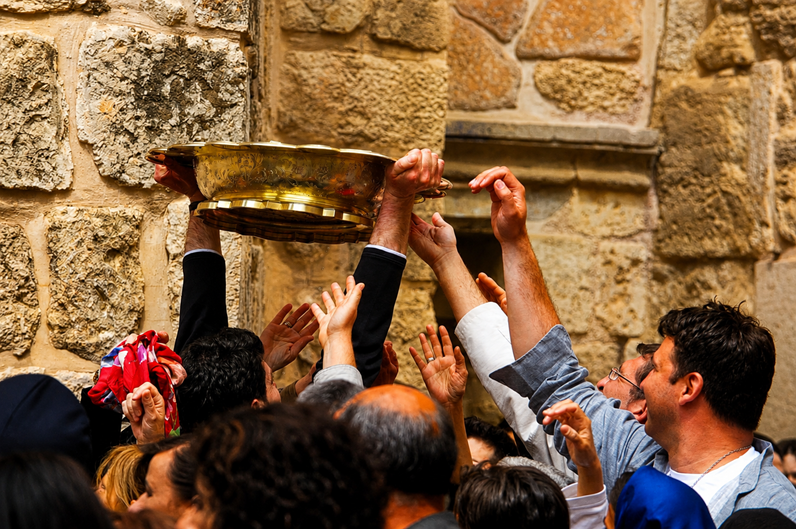
On Easter, thousands gather inside Jerusalem's Church of the Holy Sepulchre for the Holy Fire ceremony. Every December, Christmas fills the streets of Nazareth with worshippers and pilgrims from around the world. Throughout the year, believers from every continent are baptized in the waters of the Jordan River, renewing a tradition that stretches back to the baptism of Jesus.
These are not museums; they are living communities.
Across much of the Middle East, churches have watched their congregations shrink.
In Israel, churches remain filled with worshippers.
According to Israel's Central Bureau of Statistics, approximately 184,200 Christians now live in Israel, with the community continuing to grow through natural increase. Nearly 80% of Israel's Christians are Arab Christians, underscoring that this is not a story of new communities, but of one of the region's oldest Christian populations continuing to flourish.4
Israel's story is more than preserving sacred places. It is about preserving the communities that give those places life.
Christian citizens are an integral part of Israeli society. They worship freely, celebrate their faith publicly, establish churches and schools, and participate in every aspect of national life. Arab Christians consistently rank among Israel's highest-achieving communities educationally, 87.7% of Christian high-school seniors qualified for a matriculation certificate, and they are prominent in medicine, law, academia, technology, business, and public service.5
Christian citizens serve in hospitals, universities, courts, businesses, and government institutions.
Churches operate openly. Christian schools educate new generations. Pilgrimages take place freely. Religious festivals are celebrated publicly.
This reality reflects the strength of Israel's democracy and free society, the rule of law, and a longstanding commitment to protecting freedom of religion. The true measure of religious freedom is not simply the preservation of churches or holy sites. It is whether the communities who worship there are free to build families, educate their children, pursue opportunity, be part of the broad society and shape the future of their country.
Across much of the Middle East, Christianity is disappearing from the very region where it was created.
Israel, however, presents a different picture.
It has protected not only Christianity's holiest places, but also the Christian communities that continue to worship and live there.
History tells us where Christianity began. Its future depends on whether Christian communities are able to endure. If we believe that religious freedom is a universal value, then protecting the Middle East's remaining Christian communities must become a shared international priority.
Sources
1. Conrad Hackett et al., "Religious Groups' Changing Sizes in the Middle East and North Africa," Pew Research Center, June 9, 2025, https://www.pewresearch.org/religion/2025/06/09/religion-in-the-middle-east-and-north-africa/.
2. "2020 Report on International Religious Freedom: Syria," U.S. Department of State, accessed August 3, 2026, https://2021-2025.state.gov/reports/2020-report-on-international-religious-freedom/syria/.
3. "2023 Report on International Religious Freedom: Iraq," U.S. Department of State, accessed August 3, 2026, https://2021-2025.state.gov/reports/2023-report-on-international-religious-freedom/iraq/.
4. "Christmas 2025 - Christians in Israel." Israel Central Bureau of Statistics, December 24, 2025. https://www.cbs.gov.il/he/mediarelease/DocLib/2025/413/11_25_413e.pdf.