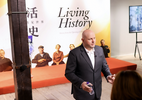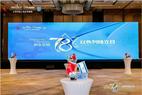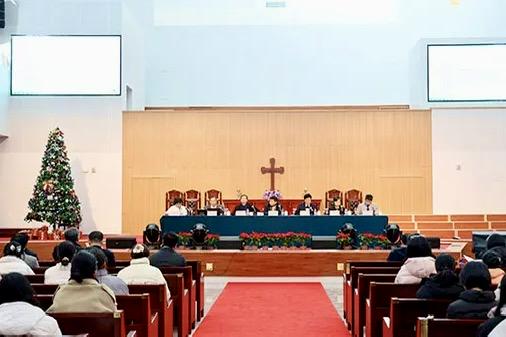
To mark the 110th birth anniversary of Bishop K.H. Ting (Ding Guangxun), a prominent late Chinese religious leader and theologian, Nanjing Union Theological Seminary (NJUST) hosted a symposium titled "The Theological Thought of Bishop K.H. Ting and the Sinicization of Christianity" on December 9.
According to the seminary, the event, which brought together scholars, church leaders, and seminary faculty from across China, served as a platform to reflect on the enduring influence of Ting on the Chinese Church. It also marked the official launch of the seminary's "Research Center for Christianity in China."
Rev. Wu Wei, president of the China Christian Council (CCC) and president of NJUTS, delivered a keynote speech highlighting Ting's role in guiding the Chinese Church to shed its "colonial characteristics" and establish a "selfhood."
Wu emphasized that Bishop Ting's advocacy for "Theological Construction" was not merely an academic exercise but a deepening of the Three-Self Patriotic Movement. He noted that Ting's life exemplified the unity of patriotism and faith, paving the way for Christianity to adapt to a socialist society.
The "Cosmic Christ"
A significant portion of the symposium focused on Ting's signature theological concept: the "Cosmic Christ."
Professor Cheng Zuming from Nanjing University noted that Ting expanded the concept of redemption from a narrow focus to include the entire universe and historical process.
This theological framework was presented as a bridge between Christianity and Chinese culture. Associate Professor Wen Ge of NJUTS drew parallels between the biblical concept of "unity in Christ" (Ephesians) and the Confucian idea of the "unity of all things" (Wanwu Yiti). He argued that Ting's "Cosmic Christ" provides a theological basis for Chinese Christians to actively participate in social construction and value truth, goodness, and beauty found outside the church.
This cosmic perspective also extends to ecological theology. NJUTS doctoral student Li Fang argued that from the perspective of the "Cosmic Christ," the human role in nature should shift from "conqueror" to "collaborator" and "steward" of God's creation.
"God Is Love" as an Ethical Foundation
Participants also explored Ting's emphasis on the nature of God, specifically his "Love Theology."
Prof. Zhuo Xinping, former director of the Institute of World Religions at the Chinese Academy of Social Sciences (CASS), described Ting's theology as distinctly "practical" and "ethical." Citing Ting's famous maxim, "Theology is the church in the act of thinking," Zhuo argued that theology must not be detached from its social context.
Scholars further explored how Ting's theology serves as a moral resource. NJUTS doctoral student Zhang Kun analyzed Ting's ethical thought, specifically his discussions on "God is Love" and humans being "unfinished products of God's creation." These concepts, Zhang argued, offer positive resources for contemporary moral construction.
Transforming Theological Education
As the long-time president of NJUTS (serving for 58 years), Ting's educational philosophy was also a focal point.
Rev. Wang Hong, president of Shaanxi Bible School, summarized Ting's vision for breaking the "monastic" isolation of seminaries. She recalled Ting's insistence that theological students should be "doubly open"—knowledgeable in both theology and social culture, striving to be both good Christians and good citizens.
Other speakers, including Rev. Luo Chengzan from Yanjing Theological Seminary, highlighted how seminaries today continue to implement Ting's legacy by building "communities of love" and innovating localized curricula.
The symposium concluded with the consensus that Bishop Ting's thought remains a vital resource for the ongoing Sinicization of Christianity.
In the closing summary, Prof. You Bin from Minzu University of China likened Ting to a multi-faceted "gem" and emphasized the need to build an autonomous Chinese theological knowledge system. Associate Prof. Wang Jiawei of NJUTS described Ting's theology as a "Banyan tree"—deeply rooted and expansive—offering shade and direction for future generations of the Chinese Church.