
More than seven decades after its formation to address the displacement of Palestinian refugees, the Department of Service to Palestinian Refugees (DSPR) is facing one of its most critical periods yet, navigating a fragile ceasefire in Gaza while continuing operations across the Middle East.
According to a situational update released by the DSPR on Nov. 21, 2025, the humanitarian landscape in Gaza remains "extremely fragile" despite a declared ceasefire. The organization emphasizes that the cessation of hostilities "does not constitute real peace" but is merely a step toward halting what the DSPR describes as an ongoing genocide against the Palestinian people.
As winter sets in, the DSPR warns that hardship in Gaza is intensifying, with more than half the population living in tents or beneath the rubble of destroyed homes.
The war's impact has reached deep into the organization's logistical capabilities, even its top leadership. Nader Anton Abu Amsha, the executive director, noted in an email to China Christian Daily that he has been unable to access the DSPR Central Office in East Jerusalem since the war began due to movement restrictions, forcing him to coordinate the regional response remotely.
"It operates under the umbrella of the four Families of Churches in the Middle East: the Orthodox, Catholic, Evangelical, and Oriental Orthodox families," Abu Amsha explained.
Established in 1948 as an ad hoc ecumenical response to the first Arab-Israeli war, the organization has evolved into a pillar of humanitarian aid in the region, coordinating relief and development efforts through five area committees in Jerusalem and the West Bank, Jordan, Lebanon, Galilee, and the Gaza Strip.
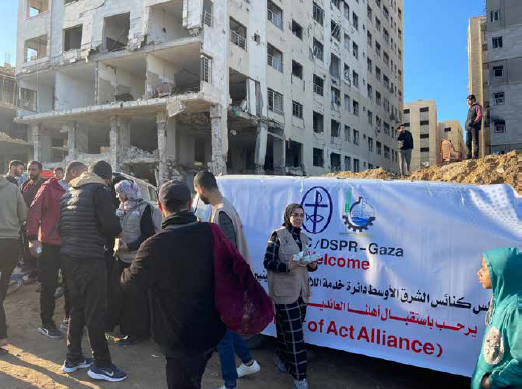
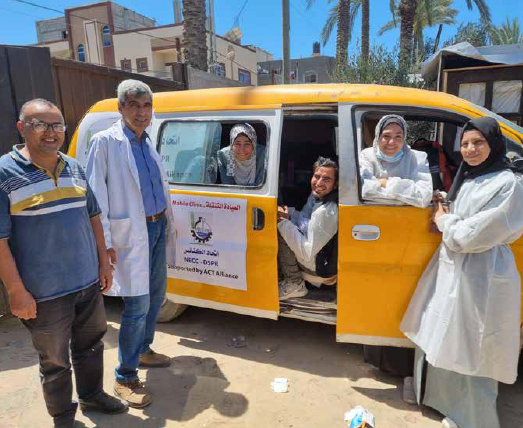
On the ground in Gaza, the operational reality is grim but resilient. Following the destruction of its original clinics during the Israel-Hamas conflict, the DSPR has established three emergency clinics: one in the Al-Nuseirat camp in central Gaza and two in Gaza City. These facilities currently treat an average of 1,200 people daily, providing medical consultations, maternal care, and pharmacy services.
However, operations remain restricted. The organization reports it is unable to work in Rafah due to the ongoing military occupation. Furthermore, while food aid is slowly entering the strip, the DSPR notes that access to essential non-food supplies—such as medicine, fuel, and tents—remains severely restricted amid the collapse of local infrastructure.
The scale of the crisis is detailed in the organization's 2024 Annual Report, titled "Restoring Dignity, Renewing Hope: A Journey of Empowerment & Resilience."
The document highlights a year marked by a 55% increase in consolidated revenues, totaling $6.59 million, driven by emergency appeals. Yet, due to the massive scale of interventions needed, expenditures rose to $6.79 million, leaving a deficit of approximately $217,000.
Beyond the financials, the conflict has exacted a tragic human toll. The DSPR is mourning the loss of four colleagues killed along with their families during the war.
"Not all heroes wear capes: some wear white robes; others welcome patients, or carry supplies, distribute kits, hand out a hot meal, and offer hope amid hopelessness," the 2024 report states in a tribute to the fallen staff.
Despite these losses, the organization's 246 staff members and hundreds of volunteers managed to reach 144,642 beneficiaries in 2024. Their work spanned health care, cash assistance, vocational training, and critical psychosocial support for thousands of women and children traumatized by the war.
The DSPR's endurance is rooted in its long history. Formally registered in Cyprus in 1970 and integrated into the Middle East Council of Churches (MECC) in 1974, it has been coordinated through its East Jerusalem central office since 1997.
Today, as it advocates for the right of return and a just peace, its mission goes beyond mere logistics.
"We serve not only because of need, but because of who we are," said Dr. Audeh Quawas, chairperson of the Central Committee, in the annual report. "Our work is not simply humanitarian or development, it is a witness."