Women make up the majority of Christians worldwide, yet they remain underrepresented in leadership and theological voice. This paradox is increasingly shaping conversations around global Christianity.
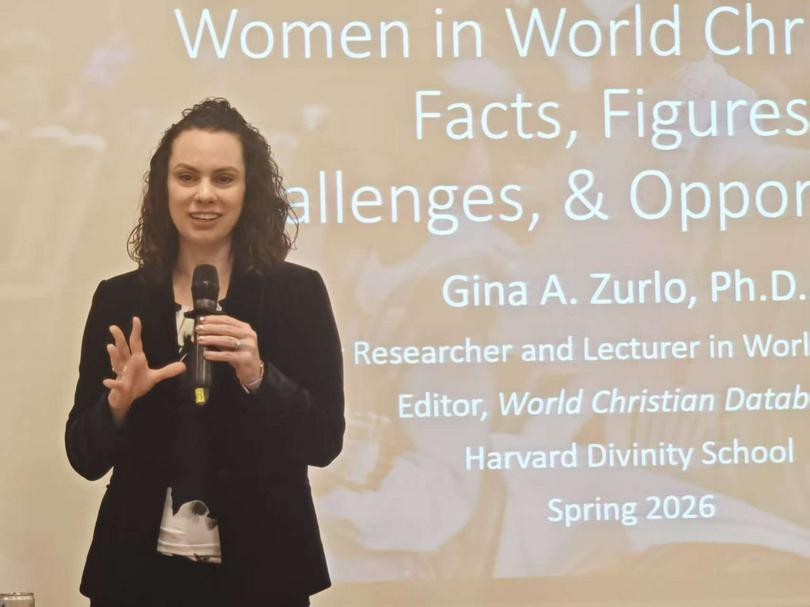
In a March visit to Hong Kong, Dr. Gina A. Zurlo, senior researcher at Harvard Divinity School and editor of the World Christian Database (WCD), shared her insights on the role of women in the global church—and what it may mean for China.
Having authored the book Women in World Christianity: Building and Sustaining a Global Movement and being named as one of the BBC's 100 most inspiring and influential women of 2019 for her work in quantifying the religious future, Dr. Zurlo is passionate about the research on world Christianity, history, sociology of religion, and women's studies.
In this interview with China Christian Daily, she discusses gender gaps, the complexity of measuring Christianity in China, and the uncertainties facing the church today.
China Christian Daily: The WCD is widely cited in global research. Could you briefly explain what makes it unique?
Dr. Gina A. Zurlo: The WCD contains data on membership and affiliation of 18 categories of religion and non-religion in all of the world's 237 countries, including Christianity at the denominational level. It is the only database that can report, for example, how many Pentecostals live in Indonesia, Methodists in Zimbabwe, and Buddhists in Norway. The WCD is updated regularly, including with baseline population data from the United Nations, country-level decadal census data, and denominational research on five-year cycles.
China Christian Daily: What led you to introduce gender as a key variable in the study of global Christianity?
Dr. Gina A. Zurlo: There was no gender variable in the WCD when I began working on the project. The WCD couldn't answer the question, "What share of Christians in the world are women?" I attended many international Christian conferences and noticed a distinct lack of women participants, especially as speakers and leaders. That experience sparked the Women in World Christianity Project, which produced the first-ever dataset on the percentage of Christian females for every denomination in every country of the world, now in the WCD.
China Christian Daily: Your presentation in Hong Kong opened with the provocative quote that "World Christianity could be considered a Woman's Movement." Since women have been the majority for at least three centuries, why do you think the academic shift to observe these "women's dynamics" is only happening now?
Dr. Gina A. Zurlo: It has only been since the worldwide feminist movements of the 1970s that scholars have paid any serious attention to women in history, social science, theology, and in other academic research. In terms of world Christianity, Dana Robert was among the pioneers of understanding the role of women in mission, most notably in her 1997 book, American Women in Mission: A Social History of Their Thought and Practice. Her 2006 article, "World Christianity as a Woman's Movement" in the International Bulletin of Mission Research, asked the question that many of us in the next generation are trying to answer: "What would the study of Christianity in Asia, Africa, and Latin America look like if scholars put women into the center of their research?" We've missed a lot about the demographic shift of Christianity to the global South by not paying attention to women, who make up the majority of members and participants in churches worldwide.
China Christian Daily: If women are so active in church life, why does the leadership gap persist?
Dr. Gina A. Zurlo: There are many reasons why these gender gaps persist, including:
-
Tradition: "We've only ever done it this way."
-
Scripture: "The Bible says women can't preach."
-
Theology: "God has ordained different roles for men and women."
-
Sexism: "Women are incapable of adequately leading churches."
In my opinion, churches can revisit these positions in light of social science research that exposes gender inequalities in faith communities, and, of course, by actively listening to women.
China Christian Daily: With staggering figures like 70% female participation in Korea and 63% in Mongolia, East Asia stands out in your research. What makes the Christian message so uniquely resonant for Asian women compared to men, and is this a sustainable model for the church's future in the region?
Dr. Gina A. Zurlo: The East Asia context is particularly challenging for Christian women. Confucian relational dynamics often make it difficult for women to obtain official leadership positions. In China, women were utterly critical in the emerging house church movement in the 1980s and 1990s. The unregistered church movement would not be what it is today without women. Yet, when these churches could operate more freely before 2015 or so, many turned to Western complementarian theology, which put women leaders in a difficult position. This potentially points to an uncertain future for Christian women. Many Christian leaders in Mongolia and South Korea also look to a particular brand of Western theology that generally does not support women in leadership roles.
China Christian Daily: By 2050, 77% of Christians will live in the Global South, according to your lecture. If the "Local Minority" status of women in leadership persists, what are the primary risks to the vitality and "prophetic ministry" of the global church?
Dr. Gina A. Zurlo: Women have always been central to the church, whether acknowledged for it or not. Some women are content to do the work they've been called to do without recognition. For others, this is not acceptable, and perhaps even hinders the work they're called to do in the world. Closing the gender gap in churches worldwide means that both men and women are fully equipped, encouraged, and can do what they feel called to do in the world. Most men do not have to question their calling or ministry, but women constantly do. As a result, men and women are asking fundamentally different questions and are having two different sets of experiences in churches—a reality that I think most men are completely unaware of.
China Christian Daily: Looking ahead, what major trends do you foresee for both women's roles in world Christianity and the future of the church in China?
Dr. Gina A. Zurlo: There are many uncertainties about Christianity in China right now, as many are aware. I think it remains to be seen the impact of particular strains of Western theology on ladies' potential leadership in Chinese churches. At the same time, I do wonder if the current crackdown on unregistered churches that has resulted in dispersion and smaller meetings means more opportunities for women, akin to the situation of the late 20th century. But, again, this is mere wondering, not prognosticating. It's difficult to speak about trends globally for women's roles because there is so much diversity. Women will continue to achieve historic "firsts," like today, the installation of the first woman Archbishop of Canterbury. Women will also continue to quietly and faithfully work to improve and support their families, communities, and congregations, just like they have always done.
China Christian Daily: You said in the lecture that a country like China remains a "black box for researchers," and your small team is now developing a custom AI model to help accelerate this complex data collection. What will the AI model look like?
Dr. Gina A. Zurlo: I can't quite share details of this yet since it's still under development.
China Christian Daily: When estimating the number of Christians in China, how does the WCD approach the gap between official and unofficial figures?
Dr. Gina A. Zurlo: It is very difficult to estimate the number of Christians in unregistered Chinese churches. The reality is that no one knows for certain, and it is not possible to obtain a precise headcount. All we can do is "expert surveys"—offering our estimates to various researchers and refining the statistics based on a wide knowledge base. All estimates are just that – estimates. But it is our hope to get as close to the de facto situation on the ground, despite the difficulties.
China Christian Daily: Historically, Chinese Christianity was seen as a rural "old, weak, and disabled" demographic. However, recent trends suggest a move toward the "Three Highs" (High education, High income, High position). Does your data support this shift, and how does the rapid urbanization of China's population affect the long-term sustainability of traditional house church models?
Dr. Gina A. Zurlo: The WCD doesn't collect this level of information on religious communities (education, income, etc.). We do know that the rapid urbanization of China resulted in an internal shift in the Christian population, where Christians were certainly among the movements of people from rural to urban. I think the shift from rural to urban also caused some confusion about the size of the Christian population. Many people thought the new urban Christians were indeed new, but perhaps they were transplants from rural areas, not real numeric growth.