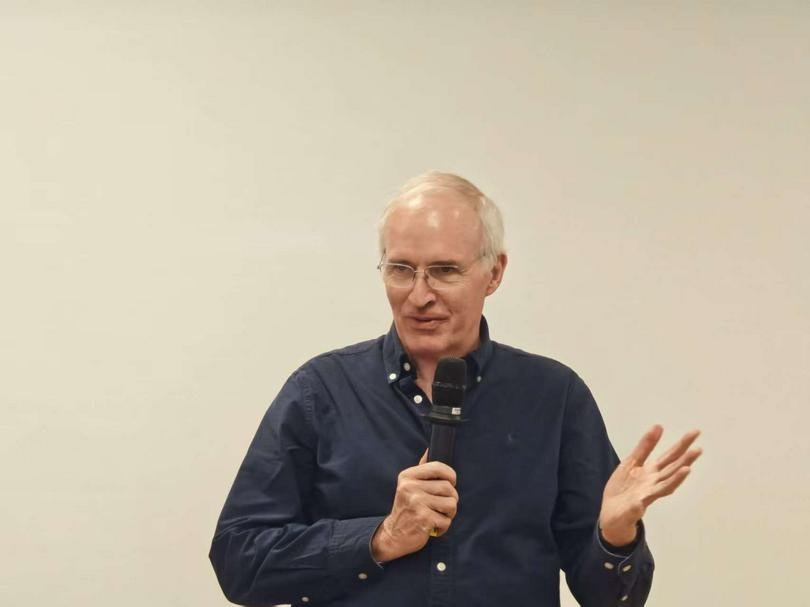
On March 23, Prof. Kenneth R. Ross, Professor of Theology and Dean of Postgraduate Studies at Zomba Theological University in Malawi, delivered a lecture titled "Current Trends in World Christianity" at Divinity School of Chung Chi College (DSCCC), The Chinese University of Hong Kong.
Hosted by Prof. Tobias Brandner, Prof. Ross argued that the dramatic demographic shift of Christianity to the Global South has created an "urgent ecumenical imperative" for the Christian faith to rediscover its unity amid mounting global crises.
First, Prof. Ross explained the origins of his research, which stems from a two-decade project that began with the 2010 centenary of the 1910 Edinburgh World Missionary Conference. This led to the creation of the Atlas of Global Christianity and a subsequent 10-volume Edinburgh Companions to Global Christianity series. The project involved more than 400 scholars and culminated in a new, forward-looking atlas with demographic projections to the year 2075.
The primary finding of this extensive research, Prof. Ross detailed, is a profound demographic realignment. He stated that in 1900, 82% of Christians lived in the Global North (Europe and North America), but by 2025, that figure had fallen to 31%. Projections for 2075 estimate that only 17% of Christians will be in the Global North, while 83% will reside in the Global South. "It's almost an exact reversal between 1900 and 2075," Prof. Ross noted, attributing the change primarily to rapid population growth in regions like Africa.
In addition, Prof. Ross observed that despite this shift, Christianity is experiencing significant fragmentation due to doctrinal differences, diverse cultural expressions, and polarizing "culture wars." He argued strongly against the narrative that the ecumenical (church unity) movement is outdated, proposing instead that it has become a critical necessity for the faith's future.
Moreover, Prof. Ross outlined four specific areas, or "ecumenical imperatives," that demand a unified Christian witness. The first is the need for a witness for peace amid rising global militarism and conflict. A united church, he argued, is required to offer a credible vision that can "reach across the divides."
Furthermore, he pointed to the complexity of intersecting global crises—including political, environmental, and economic challenges—which require a comprehensive, multi-perspective approach. Prof. Ross warned that a church defined by "just one sectional interest" risks becoming captive to other forces and losing its distinctive contribution.
A third imperative, according to Prof. Ross, arises from the current age of unprecedented global migration, which has created a "new ecumenical frontier." He suggested that in an era of rising xenophobia, an inclusive Christian vision of unity becomes a "radical witness" for bringing people together.
Finally, Prof. Ross identified the climate crisis as an existential threat that puts all other divisions into perspective. "If the house is on fire, you don't have to worry so much about some minor difference," he stated, arguing that the situation calls for an unprecedented "united mobilizing of the human community" that a unified faith can help inspire. In conclusion, Prof. Ross reiterated his conviction that rediscovering this ecumenical vision may be the "most urgent theological task of our time."
Following the lecture, Prof. Ross addressed several critical issues raised by faculty and students. On demographic shifts, he confirmed that Islam is projected to grow faster than Christianity, making interfaith dialogue increasingly vital. He also offered a provocative view on the rise of Pentecostalism, describing its intense focus on material well-being as "secularization in a religious mode."
Responding to Prof. Yam Cheuk-Yin Colten, Ross acknowledged that while the Western academy has been "slow to change," scholars in the Global South are now reclaiming their voice by creating theological frameworks rooted in their own cultural contexts.
Ross noted that the movement of missionaries from the East to the West is "already happening," citing the rapid expansion of Chinese and African Christian communities in the UK.
Addressing concerns from a Myanmar student regarding Christianity's colonial past, Ross emphasized that the faith must choose between complying with a "militarized world" or offering a "powerful counter-witness" for peace.